Month: August 2008

Beijing: Olympic road race to be postponed?

Olympic broadcasters around the world have been sent into panic as Games organisers warned them there was a chance the men’s cycling road race may be postponed because of smog.

Read more. I guess we’ll know for sure tomorrow morning.

Related news:

  • WIRED compares the air in Beijing with previous Olympic host cities.
  • USA Today: The smog endangers residents much more than temporary residents. BBC tested the PM10 (particulate matter) levels at 191 µg/l³. To compare, the San Francisco Bay Area exceeded California PM10 levels of 50 µg/l³ three days during the winter of 2007/2008. Beyond 50 µg/l³, the air is so thick with smoke it’s difficult for me to exert myself without choking on phlegm.
  • there’s definitely something in the air,” says Dave Z. “It’s like that Lynyrd Skynyrd song. ‘Oooh that smell. Can’t you smell that smell? Oooh that smell.'”
  • IOL in South Africa: The Slog Amid the Smog.

    The skies were grey and the air thick around the Olympic precinct as the South African team of Robbie Hunter, John-Lee Augustyn and David George rolled around the city’s packed roads, loosening their legs.

    They will take part in the first medal event of the Beijing Olympic Games, the men’s road race on Saturday, which takes in some of the more prominent landmarks of the city before, thankfully some of the cyclists have said, heading out of the city for the serious racing near the Great Wall of China.

  • On IOC president Jacques Rogge’s claim that what they’re seeing in Beijing is not smog, but fog: “I live in San Francisco, and this is not fog. Fog is weather — it rolls in. This just stagnates and is ripping years from my life.

I need a faster bicycle

"ON YOUR LEFT!"

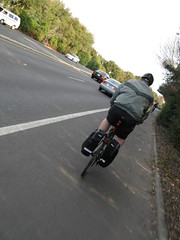
I need a new bicycle. Consider the evidence:

  • I’ve been caught and passed on Foothill Expressway this week by –
    • A large fella on a Trek Navigator hybrid bike with monster panniers;
    • A teen school girl with big foppy sneakers on a blue, full suspension Bike Shaped Object (BSO) with a squeaky chain;
    • Mr Bean;
    • A short octogenarian Asian woman toting her great-grandson on a mamachari; and even
    • Chris Cowan.

  • Getting passed by these people is bad for my ego as a professional bicycling blogger, and it’s bad for my reputation. My readers absolutely depend on my good name for their daily dose of bike news and commentary.
  • I’m clearly a better, stronger, and faster cyclist than all of these people. My jersey, socks, gloves, helmet, shades, shoes and bar tape all match, after all!
  • I ride a Specialized Roubaix, which is like the comfort bike of road bikes for old people.
  • Ken Conley, who is test riding the $6,700 Storck Absolutist 0.9 (15 lbs, SRAM Red, Zipp wheels, “stiff yet comfortable” which I suppose is another way of saying “laterally stiff yet vertically compliant”), writes “I shattered some PRs on the bike,” clearly demonstrating that it is indeed about the bike.
  • Scientific research clearly demonstrates that newer bikes are faster.

Have I convinced you? Can you help me convince my wife? And which bike should I get?

Oh, and before I forget, I owe Warren T a link because he wrote a Baiku. But his post here made me laugh.

Trek utility bike

From our spies at Trek One World Domination Headquarters in Madison, Wisconsin…

Trek was shooting some video of a prototype Gary Fisher utility bike this afternoon at the neighborhood market just down the street from us. She described it as being about the same size as the Big Dummy, but with some kind of integrated passenger seat in the stoker position, a short steel platform, and some “really cool” side bags with zippered flaps. Fat tires, disk brakes and wide upright bars.

Read more: Sconnyboy.

Hans Monderman

Tom Vanderbilt’s book Traffic: Why We Drive the Way We Do is like the Freakonomics of cars. Vanderbilt draws material from his book on this Wilson Quarterly essay about “The Traffic Guru,” Dutch traffic engineer Hans Monderman. He gained fame especially among traffic calming enthusiasts for his “shared space” approach to urban street design. Monderman found that traffic efficiency and safety improved when the street and surrounding public space was redesigned to encourage each person to negotiate their movement directly with others. Shared Space designs typically call for removing regulatory traffic control features.

Some highlights from Vanderbilt’s essay:

Traffic engineers are rather obscure characters, though their work influences our lives every day. A geographic survey of East Lansing, Michigan, for example, once found that more than 50 percent of the retail district was dedicated to “automobile space”—parking, roads, and the like. By and large, the design and management of this space is handed over to traffic engineers, and our behavior in it is heavily influenced by their ­decisions.

“Do you really think that no one would perceive there is a bridge over there?” Monderman might ask, about a sign warning that a bridge was ahead. “Why explain it?” He would follow with a characteristic maxim: “When you treat people like idiots, they’ll behave like idiots.”

“When government takes over the responsibility from citizens, the citizens can’t develop their own values anymore,” he told me. “So when you want people to develop their own values in how to cope with social interactions between people, you have to give them freedom.”


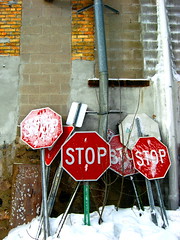
“Discarded Traffic Signs.” Photo by Ian in St. Paul, Minnesota. CC license.

Vanderbilt also discusses how Level of Service is described only in terms of motor vehicle travel — any other mode of transportation is viewed only in terms of how they hinder automobile travel, and roads are designed to remove these impediments with the idea that travel can be faster and safer.

We know our roads are not absolutely safe, of course — like Monderman predicted, the people who are treated like idiots are indeed behaving like idiots on the road. Vanderbilt contrasts this with “the improvised grass parking lots at county fairs: no stop signs, no speed limits, no markings of any ­kind—­maybe just some kids with flags telling you where to go. But people, by and large, drive and walk in a cautious manner. There is no great epidemic of traffic fatalities at county ­fairs.”

It’s a good essay and should be of interest to anybody involved in traffic safety issues. Read it here at The Wilson Quarterly. Or better yet, buy the book. Props once again to Jack in St. Louis.

Bakfiets in Chicago

Seattle bike dealer to open Dutch bike shop in Chicago

Stephan Schier of the Dutch Bike Company Seattle plans to open the Dutch Bike Company Chicago (aka Dutch Bike Chicago) in September. “We already have an enthusiastic customer base in Chicago,” Stephan tells me, so it made sense for them to open a dealership there.

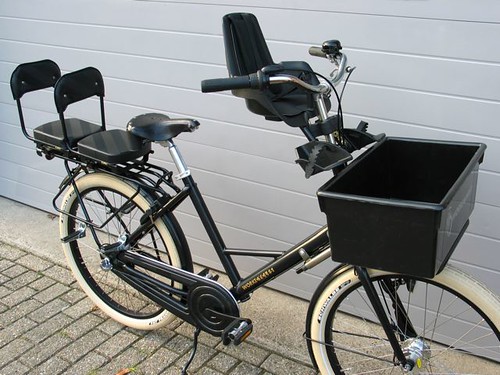
Dutch Bike Seattle is currently one of only a handful of North American dealers who imports the Bakfiets cargo bike, as well as other utility bikes from WorkCycles, Amsterdam’s utility bike experts. Stephan plans to carry these bikes in the new Chicago store, as well as bikes from the Azor brand (Oma, Opa, and Transport bikes); Danish Velobris bikes; the German Retrovelo brand; Birdy folding bikes and more.

Stephan is pretty excited about his Chicago plans. “Anyone visiting the city can see volumes of cyclists on the main boulevards on all manner of bikes and in all manner of dress. They are vying for a shot to host the Olympics and a well developed transportation infrastructure, which includes cycling, will make Chicago a highly attractive candidate.”

Bikes from WorkCycles in Amsterdam

The Dutch Bike Company will ship bikes anywhere in the United States, but shipping charges are pretty high for these heavy duty bikes. They recommend that buyers make a trip to the store and then ride the new bike home because there’s “plenty of room for your camping supplies and a cooler!”

Alternatively, Stephan says, “If there are a bunch of Bafiets aficionados who want to make a group purchase, we can likely palletize a batch, ship them by truck and drastically reduce the freight charges.”

Learn more: