Month: November 2008

Cyclocross

It’s cyclocross season, but I know nothing about that sport. I know lots of mud and cold and rain can be involved, just like a good football game back in the days when football was still played outdoors. The bikes are a little different, and there’s some lifting and running. Aficionados write and say “CX” or “cross” when referring to the sport.

So somebody school me: What attracts you to Cyclocross? Why is it fun to participate or fun to watch?

Why HAL sang Daisy Bell as he died

In one of the more poignant moments of the film “2001: A Space Odyssey,” the HAL 9000 computer sings the song “Daisy Bell” (A Bicycle Built for Two) in the final moments of its consciousness. Why was this song chosen? The use of this song was among the many inside jokes for computer nerds in the movie audience.

In 1961, “2001” author Arthur C. Clarke attended a computer music demonstration at Bell Labs using Max Mathews’ pioneering MUSIC program. Mathews, who just turned 82 years old this month, is still professor of Music Research at Stanford University. At his 80th birthday bash, Mathews gave an encore performance of a computer generated “Daisy Bell.”

Hat tip: Ed Borasky. And Elias says that it was also used by Alexander Graham Bell to demonstrate the telephone (although Daisy Bell was written nearly 20 years after Bell patented his “Improvement in Telegraphy.”) Does anybody have evidence of other early technology demonstrated with this song?

Daisy, Daisy, give me your answer do
I’m half crazy all for the love of you
It won’t be a stylish marriage
I can’t afford a carriage
But you’ll look sweet upon the seat
Of a bicycle built for two

We will go tandem as man and wife
Daisy, Daisy
Wheeling away down the road of life
I and my Daisy Bell

When the nights dark, we can both despise
Policemen and lamps as well
There are bright lights in the dazzling eyes
Of beautiful Daisy Bell

Formula 1 Racer Mark Webber rides bike, hit by car

Australian Formula 1 racer Mark Webber was injured after he was hit by a Nissan as he participated in a bicycle charity ride sponsored by him.

Webber was riding down a road in Tasmania when he was hit by oncoming traffic and broke his leg. He was attended by event paramedics before being airlifted to a hospital.

He was participating in the Mark Webber Pure Tasmania Challenge, an extreme sports charity event organized to raise funds for Australian charities.

More at Formula 1 Blog.

Holiday greeting cards for cyclists

It’s that time of year to send greeting cards to your friends, and I recommend the bicycle themed cards from Skeese Greets. They have a number of new designs for Christmas, Hanukah, and the New Year that feature bike parts in the artwork.

I first noticed Skeese Greets Bicycle Christmas cards a couple of years ago and it’s good to see the cards are still selling. Skeese Greets is Stacy Keese (S + Keese = Skeese) of Austin, Texas. As a child she wanted to be a fashion designer and grew up creating things: clothing, ceramics, and even greeting cards for family members. “In fifth grade I told one of my teachers that I wanted to be a fashion designer when I grew up,” Stacy says. “He kind of laughed at me and I think that threw me off the art / design path until after college. Now I wish I could find that teacher and tell him not to dash the hopes and dreams of students; we really can be what we want in life.”

Stacy got into creating sports greetings cards because they’re so hard to find. Her dad was a football coach, and her mom “searched endlessly for football themed Christmas cards each year.”

“When I got into cycling and triathlon, I quickly realized that there were few choices for bike themed gifts and cards. So after I helped my husband open a bike shop in Austin, TX in 2004, I started creating some designs for cyclists. I felt there was a need for it and that I was in the right environment to make it happen.”

When she’s not helping at Jack and Adams Bicycles or designing and selling greeting cards, Stacy runs the Skeese Greets Women’s Triathlon and supports other events through the year including duathlons, triathlons, cyclo-cross, charity rides, and other fundraisers. ” I think these events are really important for communities and for health, so I support them however I can.”

“The Skeese Greets Women’s Tri is an event that I started in 2007,” Stacy says. “I produce and direct the triathlon and have a lot of help from race day volunteers. Although directing a triathlon is highly stressful and time consuming, I enjoy it because it’s like throwing a party for 500 friends. It’s fun.”

Although Stacy is a tri-geek, Stacy rides a cruiser bike to get around “because I have very short commutes, plus it feels care-free and fun.”

Skeese Greets cards are sold in several online stores including Skeese.com. They can also be found in bike shops across the US and Australia. “If you want to see the cards in your favorite bike shop, tell them that you discovered the coolest bike cards ever.”

To stud or not to stud

I don’t want to sound preachy especially as I know that winter riding conditions vary quite a lot depending on where you live, but as my wife has been saying of late nothing slows you down more than falling.

Some folks live in places where there’s no snow at all, some live where snow is all there is during the winter. We live in a place where we get some snow, but a fair amount of ice. What happens is that it will snow, then melt the next warm day and then freeze again overnight forming patches of ice all over the place, often times hidden in the dark or under a fresh dusting of snow. Since the snow from the roadways largely gets plowed into the bike lanes during the winter here, those burms can go through these freeze and thaw cycles for a couple weeks after a decent storm before the coast is “all clear”.
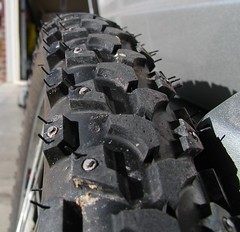
Studded bicycle tire

My thoughts regarding studded bike tires is several fold. First of all, I like riding, so if it takes a few minutes longer to ride, thats ok, its not torture its fun. Second I ride for transportation everyday no matter what the weather does, so I treat it like most would a car (do you make homemade studded tires for your car?), third nothing poses a greater threat to me enjoying my bike than crashing or be crashed into (car). For all these reasons, I find the added cost and extra rolling resistance of studded tire a non-issue for the way it transforms my winter riding experience.

Regarding cost, as this is often brought up, I spent $65 per tire last year on my Schwalbe Marathon Winter’s, they have around 3,000 miles on them from last winter and I’d venture to guess from the look of the carbide studs and tread that I can get about that much more out of them before replacing. Most decent commuter tires, by the time you factor in their mileage lifespan will work out to about $40 per tire. So assuming you’re going to ride anyway, you’re probably only going to save yourself $20-$30 over 5,000 miles running any other decent commuting tire. Consequently, if you don’t like falling, price really isn’t that big of an issue all things considered.

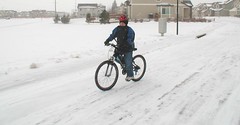
Ian rides his bike in the snow

As for what studs will do vs. what they will not do. They won’t make riding on fresh snow over clear pavement any different, nor will they make riding on layers of partially packed snow any different either. This is where tread, rubber compounds and supple tire casings come into play.

What they will do is help whenever there’s been either freezing rain or some kind of freeze and thaw cycle as back roads can often do that aren’t well maintained or like the morning after a warm day where you get glare ice. They will also make a difference on some SERIOUSLY packed snow that can almost function like ice (the smooth shiny white stuff on heavily traveled roads). Also, that rutted icy stuff that forms on roads regularly traveled but rarely plowed is also prime stud territory. Tires with studs, especially towards the edges of the tires make a big difference.

Lastly, studs won’t make it like you’re riding on dry pavement, but they will make it all predictable, in my book thats the big difference. You may lose traction if you brake harder or corner faster, but because they bite into the ice, it slows the slip enough that you can make corrections and regain traction. I’ve even gone so far as locking my front tire briefly and released and regained traction just to see how far I could push it. BTW this little test was on a high stud numbered tire 240 per tire.

And as Peter White says on his page about studded bike tires, don’t forget after you’ve been riding about capably on your studded tires, that you do NOT have studded shoes, and fall getting off your bike 😉

Wishing everyone the very best of traction this winter,

Anthony