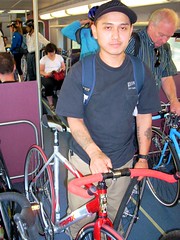
Long distance cyclist David Rowe stopped by the Santa Cruz offices of Cyclelicious during his virtual tour to promote his new book, The Ride of Your Life. Rather than focus on physical fitness, author David Rowe concentrates on the mental preparation that will ultimately make or break your commitment to training and the successful completion of “the ride of your life” ― your goal event. While other books and resources tell you how to train, The Ride of Your Life tells you how you can train. I’ve read the book and it’s very motivational.
I took the opportunity to ask David a few personal questions for this promotional tour. See below for instructions on entering this book giveaway!
A significant portion of my audience don’t consider themselves fitness cyclists — though they are serious about their equipment and about their cycling and appreciate the fitness benefits of cycling, they ride mostly for transportation. How can “The Ride of Your Life” benefit them?
Lots of us who ride bicycles for transportation have been intrigued at one time or another by the lure of a long distance ride. It’s not too much of a stretch for someone who rides to work every day to think about participating in a fund-raiser, like the ones staged by the American Diabetes Association, or the American Lung Association. Cities all across the nation stage bike to work competitions. States host multi-day organized rides. The possibilities seem to be growing all the time.
The Ride of Your Life will help that set of your readers who may be contemplating a long ride, but aren’t sure if it is for them. They can do so by carefully examining their motivations before they commit. Because once they commit, and they are into the training and preparations, they may find it difficult to keep other aspects of their life in balance as the pursuit of the goal begins to swallow up more and more of their free time.
The book is based on the notion that we can enjoy a greater sense of fulfillment in life if we know what is important to us, and then take the actions necessary to bring our experiences into alignment with those values. I think it is vital that we consider the opportunity cost of our goals, even before we start. When we do, and then begin, we are more likely to finish.
Can setting goals and planning a long distance ride benefit the utilitarian cyclist?
Some people are goal-oriented, and others are not. This book will benefit those who like to have goals in their lives. Some of my colleagues at work have set goals of riding to work every day, for an entire year. Attaining that goal is important to them and once they commit, they want to stay committed. But here in Portland, that surely means they will ride to work in the rain in the spring and fall, and on snow and ice in winter. When the set the goal, they might have been willing to endure those hardships, but did the also consider the financial expense of good rain gear? Of studded snow tires? Of waterproof panniers and racks?
There are implications for the goals we set for our bicycling lifestyles. I would like to see more riders achieve their goals, no matter what they are. I think more would if they only took the time to think them through, to know why they are doing what they are doing, so when one thing or another gets in the way of their ride, they’ll have a strong reason to keep on riding.
What about the cyclist who rides 3 miles to work everyday but dreams of a long distance tour or even a charity ride?
That rider needs to practice going long, just like anybody else. Riding to work and back is a wonderful way to stay strong and fit, but it is important to build endurance. Many of the serious cyclists at the company I work at ride just three to five miles to work each way. They have demanding jobs in the city that are waiting for them first thing in the morning, and a family waiting for them to get home at night. The way they integrate training into their lifestyles is to ride at lunch-time, three or so days a week. Then, they plan a long ride for the weekend, starting out as early as possible, so they can return home as early in the day as possible.
Every time we communicate, it seems like you’re either on your way or coming back from yet another bike ride. Do you ever wish for a recliner and video remote to just channel surf? 🙂
You bet I do! But the goals I set keep pulling me out the door and onto the road. That’s the magic of a meaningful goal. It provides the motivation I need to get off the couch and onto the bike and ride, when I’d rather be in my pajamas, drinking coffee and eating bagels and cream cheese until noon. As a matter of fact, I do stay in my pajamas until noon – but I do that on Sunday, knowing I have put my long ride in the bank on Saturday.
Marketing people make incredible use of Internet social mediatools: Facebook, Flickr, Twitter and blogging tools enable easy interaction with cyclists, fans, and consumers all around the world. Can these tools help with goal setting? Or are these un-needed distractions?
Lots of people who set big goals for themselves, which also involve a bicycle, use a blog to communicate their progress to those who care about them and their pursuits. A blog is a great place to share how you are feeling, and it’s a great place to receive encouragement from those who are following along. Many of the riders I know have a blog and they are great to read. Flickr is even easier to use. You don’t need to write a single word, if you don’t want to, and riders absolutely love to share their pictures and their progress. Beyond that a social media tools like Twitter is really quite useful in forming new relationships. I don’t know that it would help one set goal. But it certainly could help to achieve it, especially if that goal was dependent on another individual. I can’t imagine an easier way to meet people than on Twitter.
Imagine bikes shops owned by Gene Bisbee, Stevil Kinevil, Bike Snob NYC, Elden Nelson, James Thomas, Guitar Ted, Andy Singer, or Jonathan Maus. Which one shop would you like to visit? Which one shop will you send your friends to? Which one shop will you send the newbie cyclist to?
I would love to visit Elden’s shop, because imagine it would be like The Comedy Store. The only concern I have is that he’d pull me up on the stage, hypnotize me, and give me a post-hypnotic suggestion, like … “You will ride the Goldrush Randonnee on a penny farthing!” I live in Portland and I work for a New York-based company, so I’m already visiting Jonathan and the Bike Snob’s stores. I’d send newbies to Gene Bisbee, for sure. I can’t imagine a friendlier introduction to cycling than BikingBis.
Pick one: Campy, Shimano, SRAM.
Dreamin’ about puttin’ Campy on my Richard Sachs bicycle when my number comes up in 2010. That bike will be my new day racer. But you’ll see Shimano bow to stern on all of my bikes today – the durability of the Ultegra group is unbeatable.
You’re asked to testify in the conference committee meeting to negotiate the differences between the House and Senate versions of the economic stimulus bill. You have 60 seconds. What do you talk about? Which Congress person invited you to testify?
Oh geez … do we have time to get a radio receiver before I take questions on this one?
Gilligan builds a pedal powered, shaft-driven raft to get them off the island. The Professor explains that a chain is the most efficient way to transfer power. The castaways argue and take up sides — Mr and Mrs Howell side with the Professor, while Mary Ann and Ginger side with Gilligan. As the Captain, you need to cast the tie breaking vote: Do you take the raft as is with the inefficient shaft? Or do you embark on building a more efficient chain-driven raft?
This sounds like a randonneur challenge to me! I’m going with Ginger and Mary Ann, but not for the reasons you would think! The professor may be right in theory about the efficiency of a chain drive, but practically, he doesn’t have the right materials to build it. He’s always been a form before function kind of guy, and this latest recommendation proves it. Gilligan has come up with a way to get power from the pedals to the water, and he’s use materials that are durable. Chances are if they break, he will be able to find spare parts floating around. I seriously want to take this guy with me on my next 600K.
How can I get this this book?
You can buy a copy of the ebook here. Or you can try for one of three free copies the David has agreed to give away to Cyclelicious readers. David and I will pick the winners from among entrants using random.org. Rules: (1) If selected, you must provide some method of contacting you, and you must respond within a day of me contacting me via email; (2) you agree that I will pass your contact information to David Rowe. Three ways to enter — and you *can* enter three times! (1) Leave a comment here on this post; (2) Tweet a link to this post with the text Ride of your life giveaway http://www.cyclelicio.us/ #ridelife; or (3) Post a link to this blog entry from your own blog, website, or other social media page — ensure I can find it by posting a comment here if you need to and make sure your post is visible to me. If you enter all three ways (comment, tweet, and blog post), you’ll count as three separate entries. I’ll close the contest Thursday morning at 9 AM and select a winner during the day. Winners will be announced after they’ve been contacted and respond.
Good luck!

 Via Cycling News