Month: February 2009

Do they still call it ‘slashdotted’?

There’s a tech-heavy popular nerd website called Slashdot which bills itself as “News for nerds, stuff that matters.” Back in the ancient days of the web — you know, about five years ago — if a website was mentioned on Slashdot, there was a good chance the website would go down because of all the traffic inundating that site coming from Slashdot. Less robust sites are unable to deal with the flood of traffic coming from the hugely popular Slashdot, so the site goes down and is “slashdotted.”

That happened to Cyclelicious momentarily yesterday afternoon when I released the story that Lance Armstrong’s Trek time trial bike was found in Sacramento. About 1,000 people simultaneously sent a link to the story on Twitter, Stumbleupon, Digg, Reddit and elsewhere, sending a flood of traffic to Cyclelicious and bringing my site to a screeching halt. The horrible paradox is that I had record traffic to Cyclelicious yesterday, but nobody could get to the content for about five to 10 minutes.

Ah well, I’ll take the bad with the good. I really appreciate the link love that everybody sent my way! Thank you, all.

Did Cavendish jump the gun?

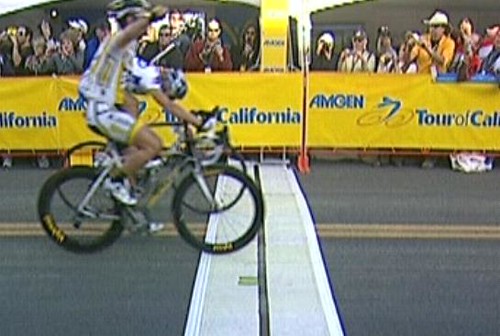
Check out this photo by my buddy Kristian shot an instant before Mark Cavendish and Tom Boonen crossed the finish line in Clovis on Wednesday afternoon.
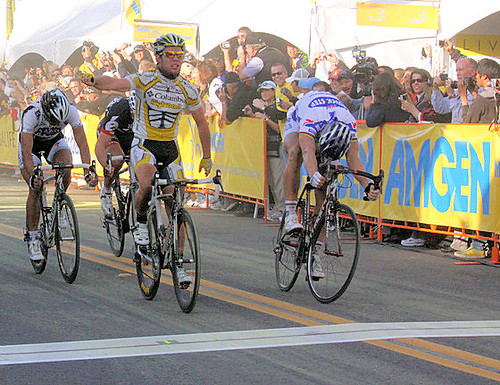
Mark Cavendish & Tom Boonen cross the finish in Clovis Amgen Tour of California

Cavendish won the race by inches, and he very well could have lost it by relaxing like he did here. You can bet Bob Stapleton showed the finish line video to this cocky young Brit. Ironically, Team Columbia High Road provided this wonderful quote from Cavendish in tonight’s press kit:

“Some people think I have a reputation for being cocky or arrogant, but I think I’m just a realist. I’m the first to say when I’m bad at something, but I’m also the first to say when I think I’m good at something. My goals are my goals, not dreams; they are targets and I’ll do whatever necessary to make those targets. So when somebody asks me if I’m the fastest, I think I am. But I need to be put in a position where I can finish it. I think I’m unrivaled.”

“This win was massive for me and for the team,” continued Cavendish. “I was really driven and I wanted this win bad. The team stayed so well together on every climb and it played into our ends today.”

The majestic views of the field flying along with the snow-capped Sierra Mountains in the backdrop amidst brilliant blue skies and sun made for a perfect day of racing.

“The scenery on the course is awesome,” said race leader Levi Leipheimer. “It’s very pretty and there were a ton of people, even in the snow, cheering for us.”

Freire Out - (c) Ken Conley
Oscar Freire out. Photo by Ken Conley

Jason McCartney (USA) of Saxo Bank drove several early moves, finally getting clear at the 26-mile mark with Serge Pauwels (BEL) of Cervelo Test Team and Rock Racing’s Tyler Hamilton (USA). Hamilton’s teammate Francisco Mancebo (ESP) joined the break as well, hoping to defend his sprint and KOM jerseys.

The first dry day of the race was marred by serious injuries to three high-profile riders: Kim Kirchen (LUX) of Team Columbia-Highroad fractured his right clavicle and scapula and Oscar Friere (ESP) of Rabobank fractured two ribs on his left side when about a dozen riders, including Floyd Landis, touched wheels and went down together in a heap. Scott Nydam (USA) of the BMC Racing Team fractured his left clavicle in a later crash. Eight other riders also dropped out on Stage 4 due to injury and exhaustion, leaving 108 cyclists to start Stage 5 in Visalia.

As the peloton continued their charge, Cavendish’s confidence grew. Mancebo stayed up front long enough to consolidate his leads, then retreated to the field to give teammate Hamilton a shot at staying away. The lead quickly climbed to more than five minutes with 50 miles to go, but with the mountains and motivated sprinters behind, the breakaway had no chance. They were finally swallowed by the fast-moving peloton at the Clovis city limits, where the Cervelo Test Team pulled to the front. But, Team Columbia-Highroad’s infamous sprinter Cavendish quickly took over for the win.

“I was looking after so well after the climbs; my team really put me in a perfect position,” said Cavendish. “Mark Renshaw (Team Columbia-Highroad) helped me; it was the first time we got the lead-out right.”

In what was a photo-finish bunch sprint to the “gateway to the sierras,” Boonen took second and Juan Jose (J.J.) Haedo (ARG) of Saxo Bank took third.

More:

Stage 4: Sprinter’s day to shine

Amgen Tour of California Merced to Clovis

Today’s stage resulted in several riders dropping out, including Oscar Freire, Kim Kirchen and Scott Nydam as they crashed on the hilly roads of the Sierra Nevada mountains. A three man breakaway of Jason McCartney (Saxo Bank), Tyler Hamilton (Rock Racing) and Serge Pauwels (Cervelo Test Team) that began before the first KOM worked together to hold the peloton back. The peloton roared through Clovis at better than 30 mph to catch the breakaway within a few short kilometers of the finish.

Cervelo jockeyed to position Thor Hushovd for a win when several sprinters rocketed through the bunched peloton, with Tom Boonen and Mark Cavendish going neck and neck across the finish line for a photo finish.

#ATOC photo finish!

UK track champion Mark Cavendish (Colubmia High Road) took the podium by inches today, with Tom Boonen beside him for second place. JJ Haedo took third place, followed by Thor Hushovd and Tyler Farrar. The GC top five stays unchanged, with Levi Leipheimer retaining the yellow jersey.

Watch for more updates through the evening at Steephill.TV.

Lance Armstrong’s bike found

Police say citizen found the bike.

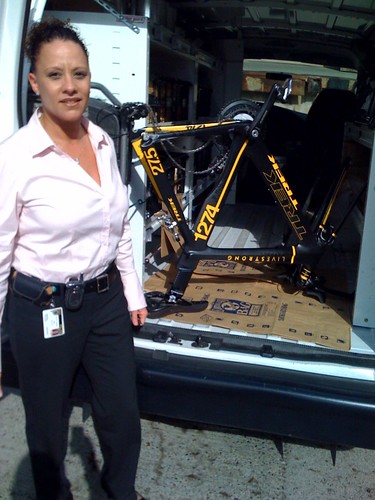
This Sacramento cop found Lance Armstrong’s time trial racing bicycle. Read details below the photo:

Lance Armstrong's recovered bike

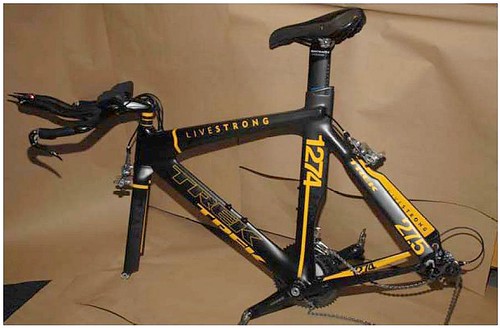
Last Saturday night, Lance Armstrong’s custom time trial bike was stolen along with two other bikes when thieves broke into a Team Astana truck parked in an alley. Initial reports said four bikes were stolen, but one of them (Jani’s) turned up in a hotel storage room Tuesday from what hotel staff said was from miscommunication between Astana and the hotel.

According to Sacramento police, a a local resident, who wishes to remain anonymous, drove to the police station and turned in a bicycle he believed was stolen from Lance Armstrong. The person is not a suspect and the police are not releasing details of how he came across the bike pending their investigation.

The bicycle is currently in the care of the Police Department and arrangements will be made to return the bicycle to the owner, hopefully in time for the Solvang time trial.

Lance Armstrong's TT bike recovered / Sacramento Police photo

I first saw this at Twitter/BizAvWeekly. You can find me here at Twitter. Are you Cyclelicious?

Maybe related:

Cycling photography tips

I’m not that great of a photographer — I’m lousy at composition, for example, and I’m not all that creative — but I do know a few things. If you’re standing along the route of a bicycle race and want to get that great shot, here are some handy tips for you.

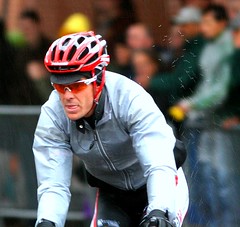
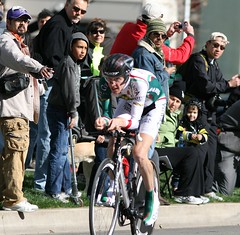
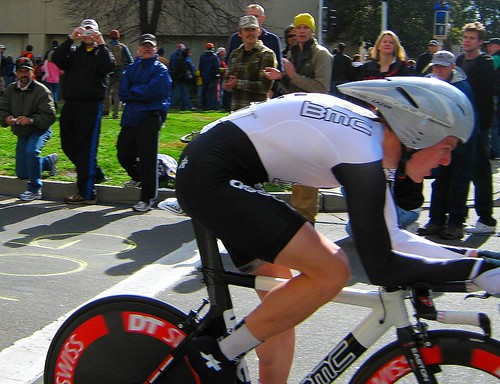
  • Get close to the action. People like to see faces, so fill the frame. You can do this with a long (and expensive) telephoto lens, or you can get physically close. Getting physically close is difficult at large races like the Tour of California, even if you have media access. Look at the race route and consider out of the way locations — you’ll miss a lot of drama, but you can get right in the action. Compare these two photos: which do you like better?

    #ATOC Splash 2009 Amgen Tour of California Prologue

  • Focus on the face. This isn’t a hard and fast rule, but it’s a good one to keep in mind — keep the focus on the face of the rider if you can. You’ll get a lot more oomph out of your photo if you can clearly seen his eyes.
  • Depth of field. The f stop is the ratio of the shutter opening to the size of the lens. Smaller numbers are larger openings: f1 means the shutter opens to the maximum diameter of the lens, while f22 and smaller are pinhole openings. Eliminate background clutter if you can by opening the f-stop of your lens as much as possible to reduce the depth of field. Your subject is in sharp focus while the rest of the frame is out of focus. Small point-and-shoot cameras aren’t capable of this, nor are the kit lens that generally come with SLR cameras.

    Because I’m a cheapskate, for me this means renting a good prime (non-zooming) lens. I shot the Tour of California this year with a Canon300mm f4 lens that I rented for about $80 for a week of use. Most of my SLR photography is with a very inexpensive but good Canon 50mm f1.8 lens. Look below to see what I mean about depth of field.
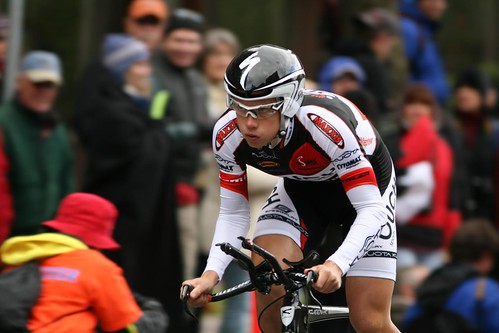
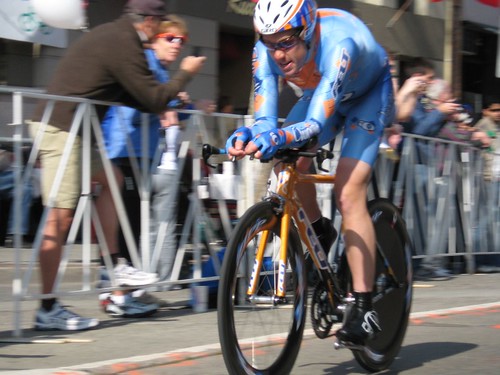
    2009 Amgen Tour of California Prologue
    Shot with 300mm at f4. Note the nicely blurred background. This is an example of a shot taken immediately after a u-turn in an individual time trial, so the cyclist is putting out his maximum effort. I try to put the AF point right on the cyclist’s nose so we can clearly see his eyes.

    20080213 055
    Shot with a point-and-shoot camera at f5.5. There’s still blurring of the background but that’s because of panning (motion blur), not depth of field. This photo was taken with I consider the best P&S camera I’ve tried: the Canon PowerShot A570

  • Avoid downhills and straightaways. If you’re on the downhill side of a hill, the cyclists will zip by so fast you’ll just get a blur if you’re lucky enough to catch anything. The same is true on the straightaways of fast time trials.

    Stage races have neutral starts where the cyclists all move at a casual pace. There’s not a lot of excitement during the neutral start but they’re safe, easy shots to get. It’s also a lot easier to identify the cyclists since they’re not battling for position — you can even look at the start list and see their relative position in the peloton to help you out.

    Good spots to camp out for drama: Behind the finish, along steep uphills, and after any turning point. At turns, the cyclists have slowed to enter the turn and are often out of the saddle to get back up to speed after the turn.

  • Know your autofocus and sensor lag. You’ll need to experiment to learn how well your camera autofocus works. Many point-and-shoot (P&S) camera AF don’t work well with fast moving action. For my Canon XTi, I manually select the AF sensor to use — I can do this very quickly without looking at the buttons.

    Many P&S cameras combine poor AF with long shutter lag — shutter lag is the time it takes between you pushing the button and image capture to take place. Generally, you want to stand to the side of the action and pan as the cyclist moves across the center of action. This is something that takes practice as you learn to time your photos with the shutter lag. Here’s a photo my daughter (age 9) took using this technique on a P&S with a 1.5 second lag — if she can do it, so can you. Composition suffers, but she got the cyclist in the frame. Notice also that the background has about the same focus as the subject because of the deep depth of field.

    Ivy's photos from Sacramento

  • Freeze the action. Some photographers do a good job showing action through blurring, but it’s hard to make this look good. You have a few ways to freeze the action effectively for a given shutter speed.

    Panning means moving the camera side to side as you follow the action. The background will be blurred (giving a good indication of movement) but the subject should be crisp. You do this by following the subject through your viewfinder then smoothly pressing the shutter release. You want to lead the cyclist — that means you want to compose the frame so it appears as if the cyclist is entering the photo; unfortunately for P&S cameras this is often impossible because the AF sensor is in the middle of the frame. On DSLRs where you can select the AF sensor, choose the left sensor if the cyclist is coming from the left; choose the right sensor if the cyclist comes from the right. Panning is essential for shooting during criteriums or in track racing.

    Get in front of the action to decrease the apparent motion. This means parking yourself at a turn or at the finish line. Remember, get their faces! Aim right at the cyclist and shoot away.

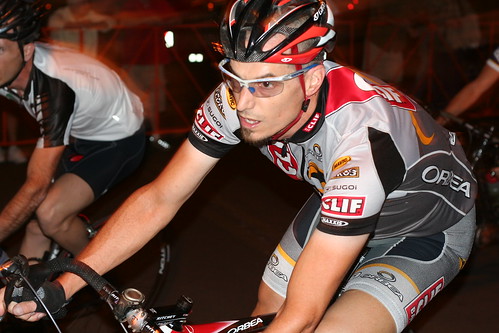
    Flash has limited application in cycling but can be important in night racing or shooting in dark conditions. Several photographers shot with flash during the 2009 Tour of California in Santa Cruz County as the cyclists ascended through heavy and dark redwood forests in heavy rain. The below is a photo I shot during a night time criterium in Las Vegas. I’m not a flash guru, so you’ll see how in my case it flattens the subject and casts a harsh light. You can get fancy with softboxes, bounces and flash brackets, but I’m likely to break anything that juts out of my camera.

    Las Vegas Criterium

  • Composition is where I have a big weakness. Here are some general tips, though:

    – Stay low to the ground. The cyclists are crouched down over their handlebars, and you can see their faces better if you’re pointing up at them. This is obviously impossible if you’re stuck three people back in a big crowd (find somebody short to shoot over), so arrive early or find an out of the way location.

    – Vertical or horizontal. I have a bad habit of focusing on the face so much that I chop out the bike. Go vertical on those individual shots if the cyclist is coming at you. Go horizontal for the arriving peloton coming over a hill or when you shoot from the side. Vertical for individual raising his arms on the podium, horizontal for all three riders on the podium. Pretty basic, I know, but I screw this one up all the time.

    – The “Rule of Thirds” is a basic composition rule that says to divide a frame into thirds vertically and horizontally and put the subject where those lines intersect. For cycling, this means leaving some space in front of the cyclist to show that he’s going somewhere. I often break this rule so my photos look a little “off” to most people (including myself). The photo at the very top of this article, for example, breaks this rule pretty badly. I was trying to focus on the rain splashing behind the cyclist but the result is something that’s a little bit ‘meh.’ Do as I say, not as I do 🙂

  • Finally, STAY OUT OF THE WAY! I see some pretty stupid stuff on the race course with photographers getting right in the path of cyclists. During Stage 2 of the 2009 Tour of California, Lance Armstrong’s personal photographer Liz Kreutz got too close to Armstrong, got bumped and caused a big pileup with bikes and cameras flying everywhere. She sent one rider to the hospital, broke two very expensive cameras and tacoed several wheels. This was actually probably the moto foto driver’s fault, but it still illustrates what can happen when you get in the way of a thundering heard of cyclists traveling at 30 mph or more.

    Also, as a matter of courtesy, stay down if there are photographers behind you.

I know many photographers follow Cyclelicious. What are your cycling photography tips?