Month: March 2009

Best Friends Forever

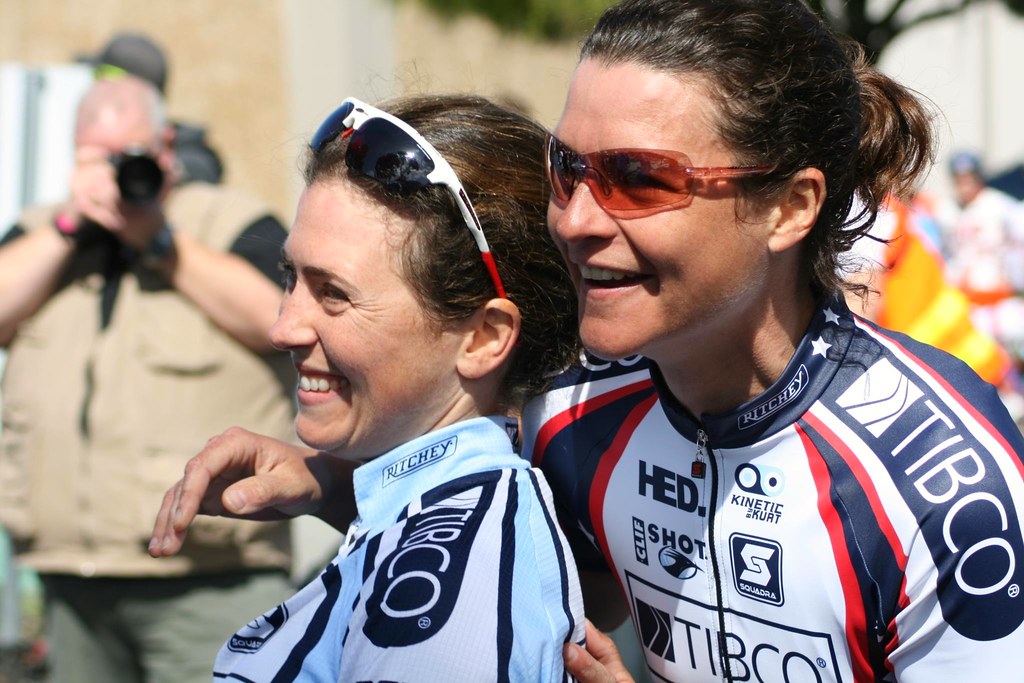
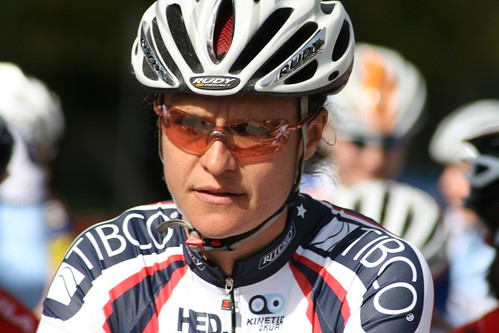
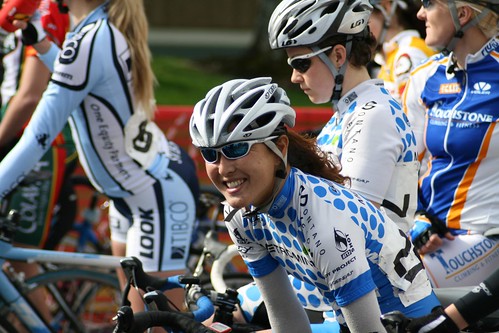
Tibco teammates Alison Rosenthal and Brooke Miller in Menlo Park.

Alison Rosenthal and Brooke Miller

This is from the TriFlow Menlo Park Grand Prix photoset at Flickr. I hope to have my photos uploaded by Monday evening. We’ll see if that actually happens.

More photos from Sunday’s Criterium by Ken Conley and by Kurt Harvey. They both do a much better job than I do. I shadowed Ken on Sunday to see how he frames the shots. He stands on his tippy toes or jumps up as he holds his camera high over head to get cool shots like this.

USA National Bike Summit tweeters

The 2009 National Bike Summit starts Tuesday, March 10 with hundreds of cycling and cyclist advocates in Washington DC to visit with Congresscritters and their aids, staffers, lackeys and hangers on.

The IMBA sent out a press release saying they’ll liveblog from the Bike Summit, but then they marvelously left out a key piece of information: Their Twitter username. Oops! After five seconds of investigative reporting, however, I’ve discovered the secret Twitter user is @IMBA_NBS, with Jenn Dice and Mark Eller hopefully providing other updates. The League of American Bicyclist will update from @bikesummit.

The hash tag for National Bike Summit updates is #NBS09 if you want to look for updates on your own. I see that Bikes Belong is also on Twitter (with a headache inducing background on their Twitter page) to provide updates from the National Bike Summit.

On the Agenda this week:

  • Several cycling advocates will lobby for climate change legislation to be introduced this week.
  • Guests at the opening plenary session including Transportation Secretary Ray LaHood, Representative Earl Blumenauer (D-OR), Representative Dan Lipinski (D-IL), and Representative Doris O. Matsui (D-CA).
  • The League of American Bicyclists annual meeting this Wednesday is open to everybody. Andreas Rohl, head of Copenhagen, Denmark’s Bicycle Office, will discuss how a city can be transformed by bicycling and Jeff Mapes, author of Pedaling Revolution, will be there signing books.
  • Every year, the Bike Summit ends with a big bike ride to the Capitol Building.

Hurray for bikes!

Where will I get run over?

Larey is a utility cyclist in Fort Collins, Colorado and he has an interesting idea: A Darwin Award with an actual cash prize.

You submit the top three places in your town you expect to get run over and put $20 into a pool. If you get run over at your #1 spot, then you get $10 for every person in the pool, get run over at your #2 spot then you get $5 from every person in the pool. #3 spot you get some sort of prize, like a pizza or something. The website could have a real time counter showing how much money is currently in the pool. It has to qualify as a major wreck so you have to either ride in an ambulance or go to the emergency room.

I’m not too sure about providing an incentive to wreck, but if I had to pick locations for getting into a major wreck, here are my top 3 picks.

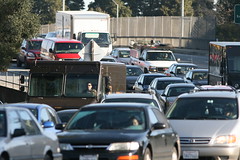
#3. Willow Road crossing over Highway 101, Menlo Park, CA. It’s actually not too bad now that I assertively take the straight through lane. I used to hug the line until I was brushed twice by a Dumbarton Express bus. AC Transit (which operates the DB Express) apologized and said they’ve given additional training to their drivers to give more room to cyclists, but I haven’t given them opportunity to prove this because I just take the lane. It seems to work well.

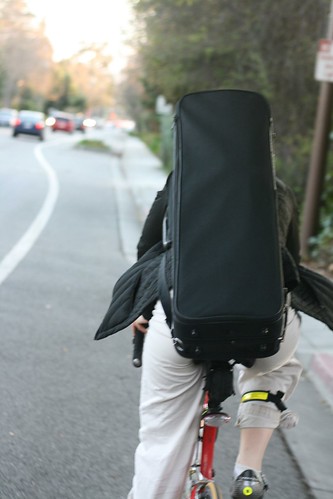
I shot the photo from Willow Road just south of the interchange and, yeah, I ride through this traffic twice every work day. This is your standard cloverleaf interchange with a busy freeway and traffic is very fast, with merges in and out of Willow Road at multiple points.

Willow Road morning traffic
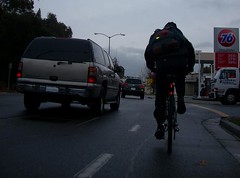
#2. Willow Road @ Coleman Avenue. This photo is taken from a couple of blocks ahead but shows a similar situation: At Coleman there’s a popular gas station and there’s a bike lane along Willow adjacent to the gas station. I’ve had several near hits with drivers hooking me as they pass and then cut right at the last minute to get into the gas station; one time an actual collision happened, though with little injury or damage to myself and my bike(and a pretty satisfying dent in the motorist’s car).

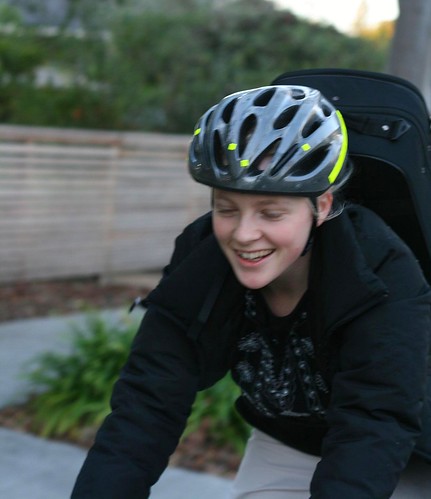
The photo is my co-worker Stephen with whom I routinely ride to and from work.

$3.58 / gallon
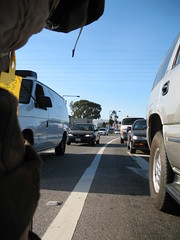
#1. Willow Road at Bayfront Expressway. This is the intersection where Pulitzer Prize-winning author David Halberstam was killed in 2007 when his driver ran a red light. The city of Menlo Park installed red light cameras here after Halberstam’s death, but I still see motorists routinely fly through reds at better than 60 mph.

Adding to the challenge is a lot of northbound Willow traffic merges right at highspeed onto Bayfront to head to the Dumbarton Bridge. I move left of the bike lane well short of the merge area to make my intention to travel straight through at this location clear, but I still witness plenty of idiots who can’t get it through their thick skulls to slow down for safety. I believe the risk is still small, but compared to the rest of my commute this is a higher risk intersection. If I get hit around Bayfront, this is the one that’s most likely to send me to the hospital.

The photo is the view from my spot waiting for the light on Willow going into the Sun Campus.

Lane-splitting is legal in California

What do you think of Larey’s idea? Where do you think you’ll crash along your commute route?

Elephant seals at Año Nuevo State Park

My wife, daughter and I visited Año Nuevo State Park today and took the elephant seal tour. Isn’t this little pup a cute one?
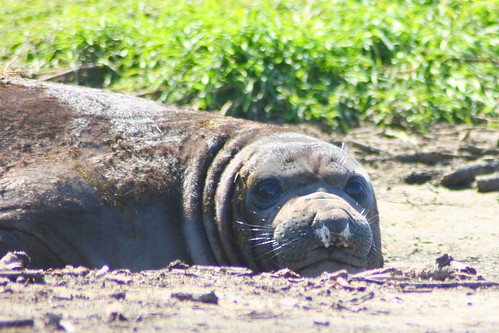
Snotty nosed pup

Northern elephant seals were hunted to near extinction in the late 19th Century for their blubber that was rendered into (tada!) oil for household and industrial use. They were thought to be extinct when a small holdout colony was found on remote Guadalupe Island in Mexico in 1906. All northern elephant seals today are descended from about a dozen individual seals from Guadalupe Island.

Point Año Nuevo is a major birthing and breeding ground for northern elephant seals, and currently thousands of pups are born each year at Año Nuevo. Females begin arriving in November to give birth to 80 pound pups. After a month of nursing, the pups have quadrupled their weight.

A month after the babies are born, the females go into estrus and the breeding season begins, during which males fight for dominance and control of the harem. Only about 1 in 10 males will ever mate during their lifetime.

The photo of the pup above is one of over 100 I shot today during the guided tour. Most of the females are gone, but several bulls remain along with a beach full of “weaners” — weaned pups. The elephant seal viewing season at Año Nuevo State Park is drawing to a close as the seals all return to their north Pacific feeding grounds, but you can still see several seals and get fairly up close to them on the tour during the month of March.

California Gray Whales are also migrating past Monterey Bay this time of year so it’s a good time to see those, too. We could see the spouts and occasional flukes from entire pods of whales as they swam off the coast this morning at Año Nuevo. We even saw one whale jump completely out of the water. Bring good binoculars for whale viewing from the coast.

Finally, I think I saw Jobst Brandt riding this morning on Highway 1. He was going the opposite direction that I was. I’ve run into him before in the Santa Cruz Mountains.

I don’t have recent photos of Jobst, but you can view my Año Nuevo visit photos here if you’d like. Enjoy!