Month: March 2009

54 miles per hour

54 mph is the fastest I’ve ever gone on a bicycle. This personal record was wind and gravity assisted on St. Vrain Road in Boulder County, Colorado as I zoomed east toward Longmont out of the Rocky Mountain foothills from Highway 36. If I recall correctly, the speed limit on St. Vrain Road is 40 mph.

The U.S. Rocky Mountains stand in the way of the west-to-east weather patterns over North America. When large weather systems move over the high mountains in Colorado, the peaks act just like pebbles in a stream, causing turbulence that can cause 100 mph winds to dip down into the Front Range. I watched one of these Chinook winds rip a storage building to shreds within minutes. These downslope winds cause millions of dollars in damage as they rip roofs from buildings and topple utility poles, but if you catch one as a tailwind while riding a bicycle, they can be a lot of fun.

This stretch of St. Vrain is also where I hit 40 mph on a fixed gear bike. That’s a lot more terrifying because I had to disengage from the pedals and just let them fly as I rested my feet on the downtube. I could theoretically have put bigger gears on the bike, but to go downhill I first had to go uphill. My usual lunch ride circuit back then was west on Nelson Road from Longmont, north on U.S. 36, east on St. Vrain, then 75th and/or Airport Road back before winding my way back to work near where the Diagonal and Hover intersect.

I’ve been wanting to beat this personal record ever since and break through the magic 55 mph barrier. I thought I’d have my chance on Sunday, with strong northwesterly winds gusting to 40 mph in northern California. I should have gone down to the coast to Highway 1, but my time was limited and I thought the hills where I live in the Santa Cruz Mountains would help.

Felton is downhill from Scotts Valley by a couple of hundred feet, but Mount Hermon Road is a rollercoaster with a couple of good downhill segments going toward Scotts Valley. I pushed west against a stiff 20 mph wind and rode to Felton, California.

It turns out, unfortunately, that the hills along Mount Hermon Road effectively block the wind — as soon as I got out of Scotts Valley, the wind was variable but mostly very light. I thought I’d try my luck on Highway 9 and went up to Ben Lomond, but all of them redwood trees block the wind, too.

My max speed today was 38 mph. Yeah, it was goofy going out for a ride for the sole purpose of going fast like the wind, but I had a good time doing it.

How about you? Do you like going fast? Do you purposely seek out strong winds and steep hills just so you can brag about how fast you went on a bicycle?
Caltrain 2 bike car sign

One of the problems with the Caltrain bike cars is cyclists often don’t know if there are one or two bike cars. There’s Twitter/Bikecar, but less than 10% of riders follow that services. It’s difficult spotting the second bike car from the usual waiting place for cyclists on the train platform.

One of the announcements at the March JPB meeting was that Caltrain was working on signs to put on the front of trains equipped with two bike cars. This “2 Bike Cars” sign was spotted yesterday on a Gallery set! I’ll try to watch for these signs this next week.

Beginning last week, Caltrain made an ffort to consistently have two bike cars on a set of trains. I purposely rode two of the trains on this list — NB 231 in the morning and SB 266 in the evening — to track Caltrain’s consistency. Out of 15 trips on those two trains, there were only two trips I noticed with a single bike car. I reported those to the SFBC bike car tracking project.

Bikes and the Blue Ocean

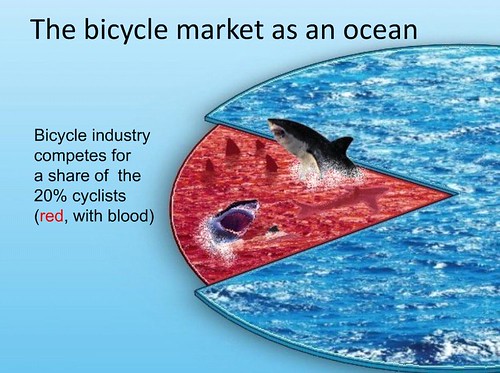
Last year, folding bike designer Mark Sanders applied the Blue Ocean marketing strategy in which he compares the international bike market to a big blue ocean of potential. There’s a small red ocean of bike enthusiasts where the major bike oceans direct all of their efforts.

Red Ocean

Mark makes the case that the bike industry should try to migrate out of this red ocean of fitness cycling into the blue ocean of “everybody else” who can use the bike for transport and leisure.

Mark is at the Taipei International Cycle Show now where he encourages bike industry leaders to apply the Blue Ocean strategy in their business to expand beyond their traditional “red ocean” market of fitness enthusiasts. It’s an important talk, I think, and Carlton Reid posted Mark’s slideshow presentation and notes online.

See also:

The Man and The Law

A little while back, the California Association of Bicycling Organizations people discussed this article in The Inland Daily Bulletin in which columnist Michelle Pearl asks the local CHP for the Final Word on traffic law for cyclists. A retired police officer “took umbrage” at an earlier statement about the legality of riding side by side on California roads, so the CHP asked Pearl to “run a correction” that turns out to contain patently untrue information.

On the CABO list, Dan Gutierrez and others highlighted what California Vehicle Code says about bicycling on public roads. LA Streetsblog published Dan’s excellent analysis of California law as it relates to Pearl’s column shortly afterwards. He also addresses the status of discriminatory laws that apply distinctly to bicycles but no other slow moving vehicles.

In spite of what the law clearly states, however, “be prepared,” as San Diego Bike Coalition board member Jim Baross writes, “to hear otherwise from your friendly cop on the street. It is not a good idea to try to argue on the spot with police folks. Take notes and deal later with a superior officer if possible.”

David Cameron on bike (again)

UK Conservative Party leader David Cameron is well known for riding his bike to get around. Here, he’s seen arriving at Parliament on March 11th. Can anybody picture U.S. House Minority Leader John Boehner riding his bike to Capitol Hill?

David Cameron Arrives At Parliament For Prime Ministers Questions

immigrants boost cycling in Oakland

In the Chron today, an article by Christopher Heredia:

despite the car-oriented landscape, residents of the city’s Latino community, for the most part, liked to get around on foot and bicycle and, as a result, were bending the neighborhood to their collective will. . . . The bicycle was a key mode of transportation even though there weren’t dedicated bike lanes . . . . they like the cacophony of cars and bicycles because it reminds them of big-city life in China.

I’m biased since I am the descendent of relatively recent immigrants, but I think immigration is the key factor keeping America strong. The U.S. has a lot to learn from other nations, and immigration is the easiest way!