Carl Batrell’s film “Fat Bike” got first place a couple of weekends ago at the Boston Bike Film Festival.
The film follows cyclists Josh Morehouse and Mike Morganson as they train in and around Anchorage, Alaska for the Susitna 100 race.
Carl Batrell’s film “Fat Bike” got first place a couple of weekends ago at the Boston Bike Film Festival.
The film follows cyclists Josh Morehouse and Mike Morganson as they train in and around Anchorage, Alaska for the Susitna 100 race.
Filmmaker Franny Armstrong tweeted last night: “Was getting attacked by feral kids with an iron bar on the streets of Camden tonight, when Boris Johnson cycled by & saved me. True story.“
Here’s the dope: Boris Johnson, who regularly bikes to and from the office, was Just Riding Along when he heard a cry for help from Franny Armstrong. Some teenagers were threatening Armstrong with an iron pipe. Johnson chased the girls away, then escorted Ms Armstrong the rest of the way home.
Boris Johnson is a pretty big dude. Armstrong admits that she had voted for rival Ken Livingstone in the 2008 mayoral election. But Ms Armstrong added: “If you find yourself down a dark alleyway and in trouble I think Boris would be of more use than Ken.”

More: –>
* Guardian: Boris Johnson saves woman from street attack. Green filmmaker Franny Armstrong pays tribute to ‘my knight on a shining bicycle’
* BBC: Johnson saves woman from ‘oiks’.
Dan Scott carries the Olympic Torch while riding his mountain bike in British Columbia. The torch makes a brilliant if awkward “be seen” light for his bike. The torch is also a reasonable gauge for those states that have passed a 1 meter / 3 foot passing law.
The Olympic Flame will be travelling across Canada on the longest torch relay within a single country in Olympic history with nearly 200 communities across Canada and 12,000 torchbearers participating.
Guest essay from Serge Issakov of La Jolla, California. Posted originally to the CABO Forum and republished here with his permission.
This reminds me of the time I was riding while pulling Anya on the trailercycle down La Jolla Blvd and stopped in the middle of the lane at a red light which soon turned green at which time we proceeded. While still in the intersection we were passed by a honking raging maniac shaking his fist at us. It was a good opportunity to teach Anya how to ignore and dismiss such occasional and very rare nuts (that was 3 years ago and none since), but the next car following him turned out to be San Diego police. The officer and I exchanged knowing glances and he turned on his lights and pulled over the guy in front of the Su Casa Mexican restaurant. We slowed to watch. Before we left I overheard the man, in a Jekyll/Hyde change in demeanor, claiming he was just trying to teach me a lesson because I was putting my child in so much danger, and the officer explaining that we were doing nothing wrong.
That said, and it’s nice to see this ahole in handcuffs, but I don’t feel the rejoicing many other cyclists have expressed about this and agree with one of the victims here who said, “It’s sad for both sides, I lost a lot of my time and my life, and he’s losing a lot of his.” There is much to be sad about here, including what the other victim said, “Our hope is that this brings to light how vulnerable cyclists are out there”. That’s not my hope, and it’s sad to me to hear that that is his hope.
Everyone is already all too aware of how vulnerable cyclists are, this doctor included, I’m sure. Cyclist vulnerability is what ironically justifies this kind of rage, for it based on the belief that riding in the road is so inherently dangerous that it is irresponsible and wrong behavior. That’s the lesson these guys (and, yes, it’s usually men) think we need to learn: “you’re so vulnerable it’s insane to be bicycling out there… here, let me show you why”. Luckily, the lesson plan is usually ultimately harmless: honking, gunning of engine, shaking of fist, screaming, a close pass. This situation, where motorist behavior actually physically harmed the cyclists, is very rare.
My hope is that this brings to light that bicyclists have the same rights and responsibilities as drivers of vehicles (CVC 21200). I hope prudent cyclists who know and follow the rules and safe practices ignore, rather than engage with, the rare ignorant motorists who try to teach us lessons about our vulnerability.
It was about a week ago in conversation a friend told me she was ‘hooked’ when a car driver passed her then immediately made a right turn into her.
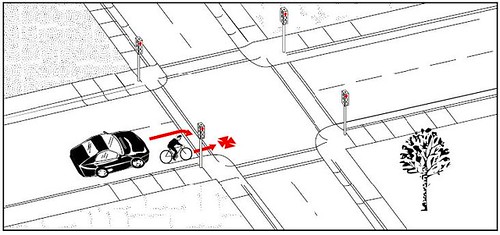
“It was so weird,” she told me. “I’ve never heard of anyone get hit like that before.”
I, in my super knowledgeable bike advocate smarminess, informed her that this collision is, in fact, the most common type of bike vs car collision. It even has a name: The Right Hook.
It turns out I’m wrong, at least in Ft. Collins, Colorado. The city traffic department analyzed accident reports involving bicycles from the year 2000 to June 2009. The infamous Right Hook — or what the city calls “Overtaking Turn Accidents at Intersections” — is the second most common collision at 13% of the total in their count.
The most common collision is “The Broadside,” at 60.5% of crashes. That’s when a motorist goes straight through an intersection even when there’s a bike right in front of him.
The Coloradoan article on this analysis highlights the fact that of the 214 “broadside” collisions, 123 of them involve a cyclist riding against traffic. Naturally, the public comments section focuses on the scofflaw cyclists as the cause of this traffic mayhem.
What the article failed to mention is that in 10% of the broadside collisions, the motorist failed to stop at a stop sign or even a red light. Two of the drivers were DUI. In 130 instances, the drivers were cited for “failure to yield right of way.”
To be sure, cyclists should ride with traffic for safety, but that’s not the only problem. There’s a problem with the bull in the china shop, and that bull should be controlled (to use the methaphor from Copenhagenize).
Left Cross
The third most common collision type is the left cross at 9.3% of collisions. This is when a left turning motorist slams into a cyclist going straight through an intersection. Of the 33 left crosses, 3 involved a cyclist riding on the sidewalk, 2 were going the wrong way, and two failed to stop at a signal or sign. The overwhelming number of these were motorists who just kept going in spite of the presence of a bike in their path.
Hit from behind
After that, the next collision type is the dreaded “Hit From Behind.” The 30 “sideswipes” recorded account for 8.5% of bike collisions. With the exception of a single head on, all fatalities are these types.
The report also counts 25 severe injury (including fatalities) collisions out of the 354 bicycle accidents in the analysis. About half of the severe injuries are from the “Broadside” collisions.
Many risks are controllable while cycling and the city report highlights some of the contributing factors that involve bicyclists — you should generally ride with traffic, avoid sidewalks, and obey traffic control signs and signals. There’s still work to do to reign in the bull as well — Ft Collins with a population of 137,000 has a serious injury accident almost once a month.
But is it dangerous?
For the 9 year period that Ft Collins examined, the accident rate is 0.93 per 1,000 population. Compare that against an injury rate of 7.7 per 1,000 population for all people involved in car accidents. There were four bicycle fatalities in Ft Collins in nine years, compared against two to four traffic fatalities total each year.
While bicycling is generally a safe activity, there are risks in bicycling, and it’s good to see Ft Collins quantifying some of those risks.
Actor Gerard Butler enjoys a crisp fall day riding his bike on the streets of SoHo.