Month: December 2009

On Wool

In my post on cycling apparel the other day, I completely neglected any mention of wool! Thank you to those leaving comments to correct my oversight.

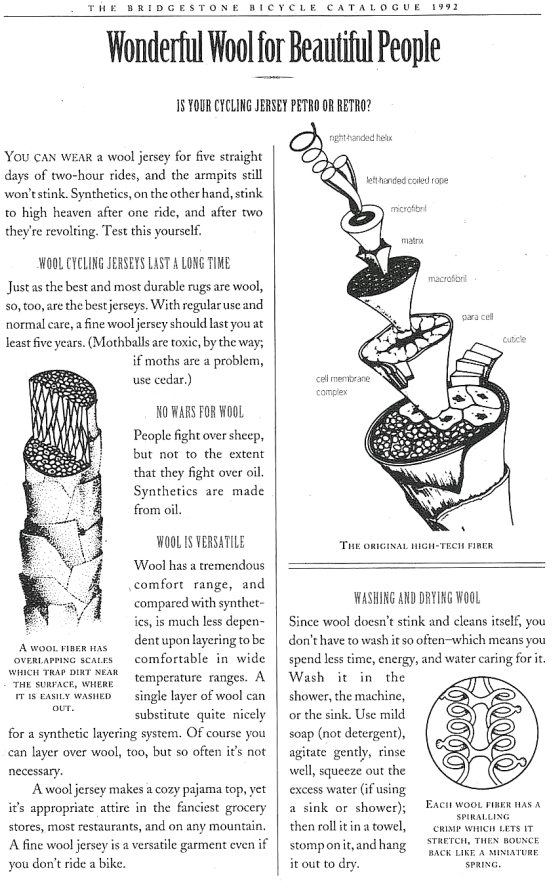
Freewheeling spirit posted his thoughts on wool and included this gem from the 1992 Bridgestone catalog.

Wonderful Wool for Beautiful People: Is your cycling jersey petro or retro?

As many of you know, Grant Petersen was USA director of marketing for Bridgestone in the early 90s, and the USA Bridgestone catalogs were a kind of predecessor to the Lauterbrunnental Leaflet Rivendell Reader, where Petersen continues his promotion of retro / practical bike craft.

Stuff I like: Bicycle magazines

Though these are mostly available online, I still like to read the dead-tree edition of magazines if I have them. A few bike oriented magazines I like that might make a good gift for the cyclist in your life:

Momentum, “The Magazine For Self Propelled People,” covers practical mobility and completely ignores racing, fitness, and pro cycling. Publisher Amy Walker and her team of editors have a real passion for what they do, and right now they have a special holiday offer: Buy 1-5 subscriptions and receive $5 off (per subscription), or get $10 off (per subscription) when you buy six or more. That’s half price!

At the opposite end of the bike spectrum is VeloNews, “The Journal of Competitive Cycling.” It’s all about racing, fitness and pro cycling. I like the writing and coverage there.
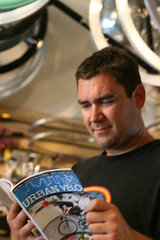
Chris reads Urban Velo Fans of women cycling will love Women’s Cycling Magazine, whose motto is “It’s About Time!”

You might be able to pick up free copies of Urban Velo Magazine at your local bike or skate shop, or you can subscribe and have it delivered straight to your door. Brad and Jeff cover urban bike culture in Urban Velo, and they always also have handy mechanical bike tips at the bag of their ‘zine.

There are several other cycling magazines out there, but those are the ones on my short list. What would you recommend for your friends?

Utah judge tells cyclists to take the lane

That’s one way to look at this story, anyways. Cyclist Curtis Adams in Logan, Utah filtered forward to the right of cars waiting at a red light. He was ticketed for violating Utah statue 41-6A-705, which states it is unlawful to pass a vehicle on the right. Judge Cheryl Russel in the city court upheld the ticket.

The way I figure it, what’s good for the goose is good for the gander. If cyclists can’t pass slow cars, then perhaps motorists can’t pass slow cyclists unless they change lanes? In this instance, though, I’m certain Logan police will probably ticket cyclists for impeding traffic. The bike program coordinator at Utah State University who was interviewed for the article also invites cyclists to take the lane — and predicts motorists might try to pass to the right of cyclists who do this.

Here’s a short video of me filtering to the right of stopped traffic in San Jose, California. (Yeah, I ride my bike on Saratoga Ave, as well as on El Camino Real, The Alameda, Santa Clara Street in San Jose, and the entire length of Stevens Creek Boulevard.)

What do you do at intersections? Do you filter forward? Or do you queue up behind the other vehicles in the lane and wait your turn?

Stuff I like: Bicycle books

I’m a book guy — I buy or borrow about a book a week. Here are some bike books your cycling friends might like as a gift. Please let me know if I missed any new books about bikes that I should list.

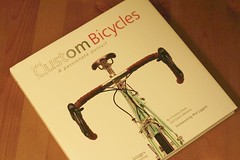
    Custom Bicycles: A Passionate Pursuit

  • Custom Bicycles: A Passionate Pursuit is a lovely coffee table book of custom bike p0rn. It’s like a portable, handheld version of the North American Handmade Bicycle Show.
  • Pedaling Revolution: How Cyclists Are Changing American Cities. Political journalist Jeff Maps writes on the history of bike advocacy in the United States. Anybody interested in how bikes related to transportation policy should read this book.
  • Kind of the same but different is Robert Hurst’s Cycling Manifesto: The case of riding on two wheels instead of four. I enjoyed the book because I like Hurst’s informal, conversational style, but this book has gotten mixed reviews because it’s not really a manifesto. Hurst examines the history of bicycling and auto use in America and around the world, taking some fascinating side trips (like how the Japanese effectively used bikes in southeast Asia during World War II).
  • Traffic: Why We Drive the Way We Do is essential for anybody involved in transportation advocacy issues of any kind, along with anyone who reports or blogs about transportation issues. Tom Vanderbilt’s book gives you a ground floor introduction to transportation planning and policy. I reviewed the hardcover edition last year — a new paperpack edition came out earlier this year.
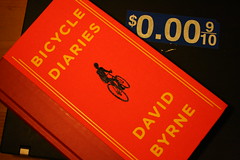
  • Bicycle Diaries by David Byrne David Byrne’s Bicycle Diaries isn’t really a ‘serious’ bicycle policy book, but rather David Byrne’s rather enjoyable stream of consciousness observations of the cities he visits and sees by bike. Byrne brings a bike with him on his travels because “I felt more connected to the life on the streets,” and he shares those connections in Bicycle Diaries.
  • I’m not a Lance-o-phile, but he’s undeniably a big name in pro cycling so I read his biography: Lance: The Making of the World’s Greatest Champion by long time cycling journalist John Wilcockson. Yeah, the title is a bit overdone, and the book reveals that I probably would not have liked Lance Armstrong if we knew each other as teens. I was the serious, studious National Honor Society dweeb and president of the computer club, and Lance: well, I’d probably be writing scathing editorials in the school paper about a certain student’s reckless driving. I was surprised to learn that Armstrong got his start in cycling by winning triathlons.

    I received Lance as a freebie. To be honest, I probably wouldn’t have given it a second look otherwise, but after I started reading I learned Armstrong’s life makes a decent biography.

    Though this is not a “tell all” book about scandal, Wilcockson gives a fairly even view of Armstrong — his shortcomings as well as his strengths. Alas, he doesn’t touch on doping other than mentioning his close association with a certain physician. Still, any friends who are LIVESTRONG fans will appreciate this book as a gift.

Are there any important new books about cycling that I’ve missed?

Update in response to Vivar’s question about bike maintenance books:

Disclosure: I bought Pedaling Revolution, Cycling Manifesto, and Zinn’s books on bike maintenance. I don’t own the Park Tool BBB. The other books listed above are pre-release review editions.