
Image by James Gosling.
Posted In Uncategorized
 January 22, 2010Leave a Comment
January 21, 2010Leave a Comment
January 22, 2010Leave a Comment
January 21, 2010Leave a Comment
Keri Caffrey was shooting video with bike patrol officer Bill Edgar of the Orlando Police Department as they took the lane for a law enforcement bike education project. A motorist lays on the horn to harass the cyclists before Officer Edgar moved over and stopped where the motorist could see his “POLICE” shirt. Edgar then asks, “Can I help you sir?”
From Commute Orlando.
See also Carlton’s POLITE shirts.
January 21, 2010Leave a Comment
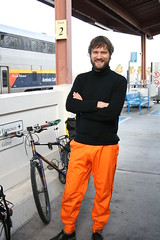
Josh Hart in San Jose wearing Rivendell MUSA rain pants.
Four decades ago, professor Donald Appleyard’s research showed the social and recreational functions of streets can be severely impaired by high-speed car traffic. His research and book Livable Streets is considered a springboard for the modern livable streets movement. In 1982, Appleyard’s life and work was tragically cut short at the apex of his career in an auto accident. A motorist travelling over 100 MPH careened out of control, crossing the median into the car Appleyard was riding in.
Josh Hart replicated Appleyard’s research while studying for his MSc in Briston, UK and found dramatic differences in neighborhood social interactions with different street traffic levels. He looked at three streets in north Bristol with light, medium and heavy traffic, and discovered that those who lived on busy streets have only a quarter of the local friends that those on light traffic streets have.
Interviews with residents show that growing motor traffic has forced people to make major adjustments in their lives, to shield against the nearly constant noise, pollution, dust and danger outside their front doors. Many residents revealed that they experience sleep disturbances, no longer spend time in the front of their homes, and curtail the independence of their children in response to motor traffic. “Our 4-year-old girl has a constant cough and we limit the amount of time she spends outside…we’re constantly breathing in pollution,” said one father interviewed for the study.

Car Free fans will also know Josh Hart for his flight free transatlantic crossing. He took Amtrak from California to Montreal, then a cargo ship to Europe, and finally rail into the UK. In Bristol, he met Louise Rouse, who would eventually travel to Japan via the Trans-Siberian Railroad!
After Josh completed his MSc in Transport Planning at the University of West England, he returned to the United States by hopping on a “repositioning” cruise ship. The cruise ship lines ferry their ships between Europe and America depending on seasonal demand, and it’s possible to book passage on those trips.
I ran into Josh on Highway 17 (of all places) and he’s a very friendly and open guy. You can meet him yourself in San Francisco this Friday, January 22 at SPUR for a lunchtime talk on his transatlantic adventures and Appleyard’s Livable Streets legacy. Donald Appleyard’s son, Bruce, will also participate in the talk. Bruce is a planner in Portland, OR and is working on a second edition of his father’s book.
SPUR is the San Francisco Planning and Urban Research Association, and they’re located on Mission about midway between 2nd & 3rd Streets. Admission is $5 for non-members. There are no bike racks at SPUR (as of the last time I was there; it might be fixed now), but there are parking meters and bike racks located on the block.
January 21, 2010Leave a Comment
I need one of these “Nubrella” space bubbles.


Just $50 from Nubrella.com.
Bike Hugger, on the other hand, suggests you can stay dry with the Raingo.
January 21, 2010Leave a Comment
James of Bicycle Design first brought the Tatoo folding helmet to my attention about a week ago.
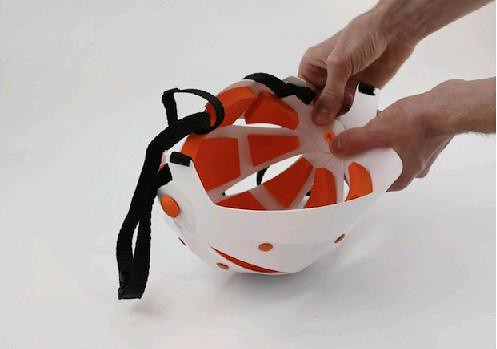

Since then, the various popular geek blogs have picked up Fast Company’s critique of the Tatoo helmet.
Firstly, one of the Tatoo innovations: It’s made completely of polypropylene and is recyclable. Bicycle helmets are mostly made from expanded polystyrene with other plastics and glues that make recycling difficult.
And that leads to the problem with Tatoo: It’s not made with crushable polystyrene foam. The Tatoo design website touts the high “absorption power” of expanded polystyrene as well as its lightweight. There’s a reason helmet manufacturers overwhelmingly use polystyrene, though: you get a lot of protection for the weight. They’re designed to crush on impact to protect your head. The bouncy property of polypro might make your head bounce as well, resulting in increased trauma on your brain.
I’m told that expanded polypro is used in some helmets, especially those that are designed for multiple hits like multisport helmets. You’ll note that multisport helmets tend to be heavier and less well ventilated than the Tatoo bike helmet seems to be. I imagine there’s a reason for that.
James (of Bicycle Design, again), points, however, to some criticisms of current helmet design: namely, there’s generally little evidence of crushing in real accidents.
What in fact happens in a real crash impact is that the human head deforms elastically on impact. The standard impact attenuation test making use of a solid headform does not consider the effect of human head deformation with the result that all acceleration attenuation occurs in compression of the liner. Since the solid headform is more capable of crushing helmet padding, manufacturers have had to provide relatively stiff foam in the helmet so that it would pass the impact attenuation test.
Cozy Beehive has a pretty good “How Helmets Work” article if you want to look into this a little more deeply. I live just a few blocks from the world headquarters of Bell Sports / Giro / Easton, so I might take a stroll down there and ask for their input on this. Unfortunately, the person I know best at Bell is retiring from her job at the end of this week, so I guess I need to cultivate a new contact there.
B+ on creativity and effort, C- on researching actual requirements for bike helmets.
For a recyclable helmet designed with US CPSC helmet safety standards in mind, see Logan Vickery’s Eco Lock bike helmet.
January 20, 2010Leave a Comment
I admit it, I’ve been riding fenderless this week during our California rainstorms. The reason: my fendered rainbike is out of action with a broken brake cable. Yes, I should fix it, but it’s just so much easier to grab another bike, and it really hasn’t rained that hard (until today). My raingear has kept me dry, but I’m sure the spray is annoying to following cyclists, and spray from the front tire hits my face.
Here in the Bay Area, even the recreational road cyclists have fenders on their bikes. The Guardian has a humorous piece shooting down the usual excuses people don’t use fenders.
See also Velo Flaneur’s Southern California Fender Primer.