
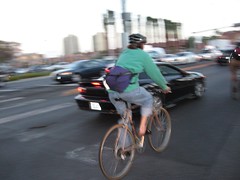
 Early this year, the U.S. League of American Bicyclists adopted an “EQUALITY” statement, adding this as a sixth E to the traditional “Five Es” (engineering, education, encouragement, enforcement & evaluation/planning) in which bicycle friendliness is evaluated. The League’s policy is to promote equal legal status and equal treatment of cyclists in traffic law. All US states must adopt fair, equitable and uniform traffic laws, that are “vehicle-neutral” to the greatest extent possible. Cyclists’ ability to access to all destinations must be protected. State and local laws that discriminate against cyclists, or restrict their right to travel, or reduce their relative safety, must be repealed.
Discriminatory laws are on the books in most states that apply only to cyclists and to no other vehicles. In California, for example, CVC 21202 is the familiar “far to the right” law, when another law on the books (CVC 21654) already provides a “as far right as practicable” provision for all slow vehicles.
Other discriminatory laws that apply only to cyclists and no other slow vehicles include mandatory sidepath laws (13 states have this), mandatory shoulder use laws (5 states), mandatory bike lane laws (5 states, including California), and far to the right laws that apply only to cyclists (41 states, including California).
What do you think? Are “Far to the Right” laws discriminatory and should they be repealed? For some background, read California LCI Dan Gutierrez and Amanda Eichstaedt’s article promoting the Equality clause, and then read the discussion that follows discussion of the Woolley case in San Diego, in which bike lawyer Rick Bernardi believes “Far to the Right” citations are easier to fight than a Slow Moving Vehicle citation.
Yes. Not just due to discrimination but because the laws are contrary to social interest. It is in the interest of society to encourage cycling and reduce driving. So if cyclists are slowing drivers down, then good. Fast automobiles are not good for society, witness the # of deaths per year due to automobile crashes and collisions.Why do we need to move 2 extra tons around with each person? It is an insane multiplier, we are moving 2100% of a persons mass when we drive a car(assuming a 200lb person). SUVs and trucks are much worse. I don't get it.
Yes. Not just due to discrimination but because the laws are contrary to social interest. It is in the interest of society to encourage cycling and reduce driving. So if cyclists are slowing drivers down, then good. Fast automobiles are not good for society, witness the # of deaths per year due to automobile crashes and collisions.
Why do we need to move 2 extra tons around with each person? It is an insane multiplier, we are moving 2100% of a persons mass when we drive a car(assuming a 200lb person). SUVs and trucks are much worse. I don't get it.
Robert Hurst, author of the excellent "Art of Urban Cycling" makes an interesting point: that making cyclists truly "equal" is actually a step backward.Smart, careful cyclists can more or less do anything they want and go anywhere they want and most of the time there are no consequences. This has been my own experience. I've never once been hassled by police for taking up lanes anywhere I've ever ridden. I think at this point most civilians and cops are at least used to the idea of bikes in the lanes.Note, also, that I've lived on the left coast all my life, so my perceptions are biased.
Robert Hurst, author of the excellent "Art of Urban Cycling" makes an interesting point: that making cyclists truly "equal" is actually a step backward.
Smart, careful cyclists can more or less do anything they want and go anywhere they want and most of the time there are no consequences.
This has been my own experience. I've never once been hassled by police for taking up lanes anywhere I've ever ridden. I think at this point most civilians and cops are at least used to the idea of bikes in the lanes.
Note, also, that I've lived on the left coast all my life, so my perceptions are biased.
Does anyone know if Bicycle Friendly City criteria include "equality" of facilities distribution?This discussion seems like it will parallel ones about affirmative action when it comes to race and gender.What if we removed the laws about turning right or left in front of a bicyclist (as in Chicago) because it was not "vehicle neutral"? Then, bicyclists would be put back in harm's way (assuming the law is shown effective in the years after passage).
Does anyone know if Bicycle Friendly City criteria include "equality" of facilities distribution?
This discussion seems like it will parallel ones about affirmative action when it comes to race and gender.
What if we removed the laws about turning right or left in front of a bicyclist (as in Chicago) because it was not "vehicle neutral"? Then, bicyclists would be put back in harm's way (assuming the law is shown effective in the years after passage).
@Duncan Watson"So if cyclists are slowing drivers down, then good. Fast automobiles are not good for society, witness the # of deaths per year due to automobile crashes and collisions."So when my wife is dying as I drive her to the hospital, I should have no problem with a guy taking a recreational ride blocking the lane, forcing me to go 12 mph?Look, I bike to work every day. I know the benefits of cycling/more people cycling. But to say that all cars should travel at the speed of a bicycle is just completely asinine. I agree with Doug, quoting Robert Hurst. For the most part simply being smart and choosing when to take the lane, you'll be fine. Yes, you may get harassed now and then, but you get harassed for driving a car correctly sometimes too.Life is not a sunlit ride down a fully protected bike lane. Get over it.
@Duncan Watson
"So if cyclists are slowing drivers down, then good. Fast automobiles are not good for society, witness the # of deaths per year due to automobile crashes and collisions."
So when my wife is dying as I drive her to the hospital, I should have no problem with a guy taking a recreational ride blocking the lane, forcing me to go 12 mph?
Look, I bike to work every day. I know the benefits of cycling/more people cycling. But to say that all cars should travel at the speed of a bicycle is just completely asinine.
I agree with Doug, quoting Robert Hurst. For the most part simply being smart and choosing when to take the lane, you'll be fine. Yes, you may get harassed now and then, but you get harassed for driving a car correctly sometimes too.
Life is not a sunlit ride down a fully protected bike lane. Get over it.
Equality is tricky, since bicycles are not equal to motor vehicles with more than two wheels when it comes to speed, acceleration, security on slippery pavement, protection from the weather and the ability to power large amounts of night-time illumination using normal systems of the vehicle.Yes, cars and trucks slide on slick stuff, but they don't fall down as readily as bikes. Yes, in traffic a bike can make much better time than a car. Things get dangerous when the motorists can use their size, speed and acceleration to maneuver in ways that endanger lower-powered road users.We use ridiculously large, powerful vehicles to get around because it was easy and relatively cheap. We stick with it out of addiction and habit. Those will be hard to change.Doug (and Robert Hurst) are right: unequal but relatively unnoticed, cyclists can take advantage of many more of their strengths than if any legislative body tries to delineate those strengths and set standards for their legal use. This freedom isn't free: we have to find and utilize our own safe zones from among the hodgepodge of facilities and laws that do exist. For that matter, the freedom of cycling carries its price in our exposure to harm and weather, and our need to exert to make the machine carry us.I yearn for Biketopia, but I acknowledge how difficult it will be to institute it.
Equality is tricky, since bicycles are not equal to motor vehicles with more than two wheels when it comes to speed, acceleration, security on slippery pavement, protection from the weather and the ability to power large amounts of night-time illumination using normal systems of the vehicle.
Yes, cars and trucks slide on slick stuff, but they don't fall down as readily as bikes. Yes, in traffic a bike can make much better time than a car. Things get dangerous when the motorists can use their size, speed and acceleration to maneuver in ways that endanger lower-powered road users.
We use ridiculously large, powerful vehicles to get around because it was easy and relatively cheap. We stick with it out of addiction and habit. Those will be hard to change.
Doug (and Robert Hurst) are right: unequal but relatively unnoticed, cyclists can take advantage of many more of their strengths than if any legislative body tries to delineate those strengths and set standards for their legal use. This freedom isn't free: we have to find and utilize our own safe zones from among the hodgepodge of facilities and laws that do exist. For that matter, the freedom of cycling carries its price in our exposure to harm and weather, and our need to exert to make the machine carry us.
I yearn for Biketopia, but I acknowledge how difficult it will be to institute it.
Doug alludes to the history of why some of these bike only laws exist. Even before autos were common on the roads, there were attempts to ban bikes completely from public rights of way. These laws were part of the compromise to allow bikes to use the road. The argument of those who want to repeal bike-only laws is that these laws encourage and legitimize official harassment of cyclists who want to get around.9 states and the District of Columbia don't have Far to the Right laws, and I don't know that bicycling is substantially worse (or traffic unnecessarily impeded in a worse fashion) than in the other 41 states.@Tony: For everybody under 44 years old, an auto accident is one of the most likely causes of death, and speed is usually a contributing factor. If you're driving your wife to the hospital, it's probably other cars on the road, red lights and so forth that will impede your way more than any bicyclist. Also, the slow moving vehicle law in every state still applies — cyclists must still right as far right as practicable. The LAB position is that bicycle-only FTR laws are redundant and unnecessarily discriminatory.
Doug alludes to the history of why some of these bike only laws exist. Even before autos were common on the roads, there were attempts to ban bikes completely from public rights of way. These laws were part of the compromise to allow bikes to use the road. The argument of those who want to repeal bike-only laws is that these laws encourage and legitimize official harassment of cyclists who want to get around.
9 states and the District of Columbia don't have Far to the Right laws, and I don't know that bicycling is substantially worse (or traffic unnecessarily impeded in a worse fashion) than in the other 41 states.
@Tony: For everybody under 44 years old, an auto accident is one of the most likely causes of death, and speed is usually a contributing factor. If you're driving your wife to the hospital, it's probably other cars on the road, red lights and so forth that will impede your way more than any bicyclist. Also, the slow moving vehicle law in every state still applies — cyclists must still right as far right as practicable. The LAB position is that bicycle-only FTR laws are redundant and unnecessarily discriminatory.
@Tony Also I wouldn't recommend anyone driving a dying person to the hospital. An ambulance can get them there faster, know which hospital would be able to take them, plus it has life support equipment and personnel on-board to treat them on the way.
@Tony Also I wouldn't recommend anyone driving a dying person to the hospital. An ambulance can get them there faster, know which hospital would be able to take them, plus it has life support equipment and personnel on-board to treat them on the way.
Seconds ago I had a long drawn out comment with 47 sub points on why it's confusing to have "ride to the right" as a law. I think it boils down to this question.Under what circumstances do we see someone getting a ticket for not riding far enough right?I classify "ride to the right" as a good, general bike safety tip.
Seconds ago I had a long drawn out comment with 47 sub points on why it's confusing to have "ride to the right" as a law. I think it boils down to this question.
Under what circumstances do we see someone getting a ticket for not riding far enough right?
I classify "ride to the right" as a good, general bike safety tip.
This post has obviously raised many interesting points. many readers recognise that cars are wasteful, and primarily used out of habit here in the States. We just did a piece on how car-culture affects health. Patti offers a European perspective, including the integration of bicycles into a daily routine. check it out: http://speakhealth.org/can-you-stay-fit-in-a-car-culture/love to hear what you & your readers think, or if you have anything to add! ~c
This post has obviously raised many interesting points. many readers recognise that cars are wasteful, and primarily used out of habit here in the States.
We just did a piece on how car-culture affects health. Patti offers a European perspective, including the integration of bicycles into a daily routine. check it out: http://speakhealth.org/can-you-stay-fit-in-a-car-culture/
love to hear what you & your readers think, or if you have anything to add!
~c