
Peter Smith (Google Maps Bike There) stirs up controversy by advocating for sidewalk riding.
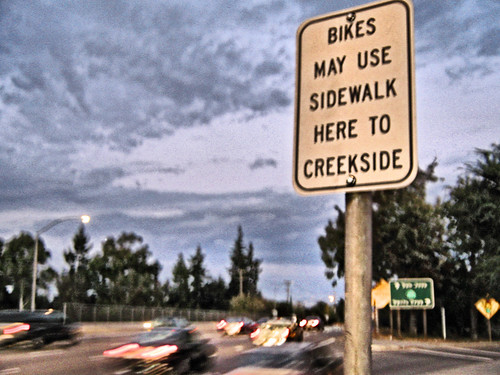
And when measured in the most critical terms — your ability to bike another day — you are almost certainly safer on the sidewalk than in the road — because most collisions occur in the road — i.e. doorings, hit from behind, etc.
So when certain ‘advocates’ tell cyclists not to ride on the sidewalk — they are effectively telling these cyclists to stop riding — which makes riding overall that much more dangerous for everyone else — because of the safety in numbers effect, in reverse.
About 11,000 people commute to work by bike in San Jose, California on a regular basis. Another 8,000 school children ride their bikes to school. If what I see is any indication, almost all of those children bike on the sidewalk, a probably a good 50% of those adult commuters seem to ride on the sidewalk for at leat part of their journey.
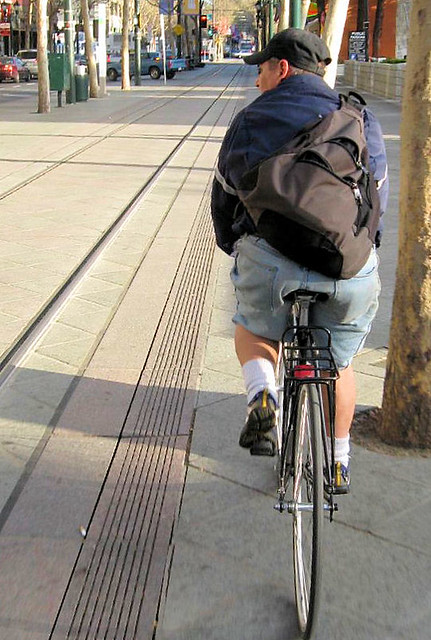
I don’t have a statistical breakdown, but scanning the San Jose police blotter shows the large majority of bike vs car collisions involve a sidewalk cyclist. Most result in minor injuries (scrapes and bruises) at the very worst, though there has been at least one fatality in recent memory when a driver turned left across an intersection occupied by a 12 year old girl. The few times I’ve personally witnessed a bike vs car crash in San Jose, it’s always been a sidewalk cyclist.
Does sidewalk riding entail more risk? Certainly. Even Dutch studies show more risk of an injury crash for cyclists in their vaunted cycle tracks. But I think Peter SMith is onto something in calling out the exaggeration risk many of us claim. If sidewalk cycling is really as bad as some of us say, the gutters of San Jose would be rivers of blood from all of the slaughtered sidewalk cyclists. That doesn’t seem to be the case.
Perhaps a better discussion might be how to recognize and mitigate the risk, though the biggest challenge in sidewalk cycling is recognizing the potential conflict points. I confess to sidewalk riding in a couple of places, mostly to avoid multiple left turns across large intersections to get to my destination. Even on familiar sidewalks, though, I’ve been blindsided a couple of times by a car coming from a completely unexpected direction. In both of those cases, a crash and injury were avoided by the diligence of the drivers (God bless ’em).
If you read the essay, avoid the video he embeds — it’s insulting and adds absolutely nothing to the conversation. Baltimore Spokes includes this introduction / disclaimer / warning / apology at the top of his page where he links to the essay.
While I am not a huge fan of sidewalk cycling I do understand why many prefer it over riding in the street. As the article points out the criteria for when it is allowed and when it is not is … well all messed up. But for safety my own research points to the fact that riding against traffic either on the sidewalk or on the street is very risky and a lot of people do it. I will further assert including wrong way riding in the stats for comparative risks throws the whole comparison off.
It is noteworthy that you cannot safely do near traffic speeds on the sidewalk like you can in the street. Viable transportation needs to have an element of swiftness. While accommodating slow beginners is a good thing, there is a fear that allowing sidewalk riding will make street riding seem unsafe, thus penalizing those of us who go faster and further by bike. This topic should be approached with caution as both can be safe if precautions are taken and both can be unsafe if no thought to the potential hazards is ever done.
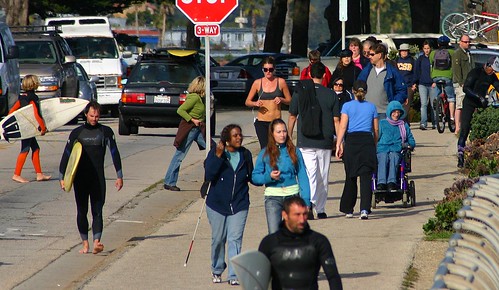
Via Biking In LA.
What he fails to mention is that sidewalk riding is illegal for adults (or even 14+) almost everywhere. Whether an individual thinks it’s right or wrong, it’s likely still illegal. Most people skirt the laws on occasion when it’s just so much more convenient, but to advocate for all cyclists breaking the laws seems a bit odd here.
You make an excellent point about speed. I can ride 15-20mph on the road pretty easily with few reasons to change my speed or direction, but on a sidewalk, anything more than the speed of walking is pretty hairy. There’s significantly more things in the way, or coming into the way, and a much smaller space to maneuver through. Plus the sidewalks I’ve been on generally have many more bumps, broken sections, and other poor riding conditions that are just better off avoided by wheels.
And finally, while actually riding on the sidewalk might be reasonable in some limited situations, I find sidewalk riders 4324.8% (rough estimate) more likely to just keep rolling past the sidewalk, crossing streets with no regard for traffic. Peter might think that riding ON the sidewalk is okay, but when that promotes unskilled cyclists rolling across intersections unpredictably, it’s a recipe for bad news eventually.
“If sidewalk cycling is really as bad as some of us say, the gutters of San Jose would be rivers of blood from all of the slaughtered sidewalk cyclists. That doesn’t seem to be the case.”
I think this is true of just about any of the most mentioned safety concerns voiced about cycling. It all seems to start with the assumption that what you’re doing is inherently dangerous, and you need to do anything and everything in your power to mitigate those dangers. Is cycling on the sidewalk more dangerous than cycling on the road? Statistically it seems that it probably is. Likewise getting knocked on the head with a helmet on is probably less dangerous than getting knocked on the head without one. Statistically I’m probably better off with lights after dark.
But even with all those concerns, statistically I’m not all that likely to be seriously injured when biking. In this country at least, it seems we’re most likely to die from heart disease than anything else, and risk for heart disease increases with obesity and physical inactivity. Which makes me wonder if I’m still statistically likely to die of heat disease if I ride helmetless on the sidewalks against traffic after dark with no lights? Hard to say as we’re piling on a lot of risk factors, but then they are a lot of risk factors that I suspect a good number of people are already guilty of. As a young cyclist I am certain I committed all of those infractions, and it wouldn’t surprise me if I’d done them all at once. I know better now, although even now there are times when I commit some of these offenses.
It is certainly worth knowing and worth passing on what can be done to make cycling safer, but it seems like we do a disservice if we attempt to scare people straight and as a result scare people off their bikes and into a more dangerous, sedentary lifestyle. The linked article seems a little confusing when dealing with whether or not sidewalk cycling is more dangerous than road cycling. Numbers I’m familiar with seem to indicate that sidewalk cycling is more dangerous. But I agree with his final conclusion that encouraging cycling is more important than discouraging sidewalk cycling. I think there’s a strong reaction to many safety topics in which we rail against certain behaviors with the best of intentions, but if we do it in a manner that might discourage cycling in general, we may not have helped anyone.
I think the largest problem with sidewalk riding is the sheer vagueness of what is, and what isn’t, allowed for bicyclists. Even once that definition is nailed down, it can radically shift simply by crossing over an imaginary line into another jurisdiction.
When I worked for the LADOT Bike Blog, we put together a listing of the sidewalk riding rules for every city in LA County. http://ladotbikeblog.wordpress.com/bikes-on-sidewalks/ What it came out looking like was a hideous jigsaw of contradictory rules for cities throughout the county, peppered with cities who didn’t even bother to have text in their municipal code regulating the rules of sidewalk riding. Some cities explicitly included “public tennis courts” along with sidewalks, others had specific language that you could have your bike on the sidewalk only so long as you were in the process of locking it to a bike rack.
Take, for example, Beverly Hills. Sidewalk riding is banned in “business districts”. Sounds simple, no? Well, once we dove into the actual CVC definition of “business district”, it turned out to be any block where half of the buildings are made up of pretty much anything that isn’t a single family home. That means you could be on a block with half apartments and half single family homes, nowhere near a single business, and it’s illegal to ride your bike on the sidewalk. And if you happen to cross over into West Hollywood, suddenly sidewalk riding is legal except where a bike lane is provided on the street. And if you cross over into LA, you have no restrictions at all on sidewalk riding. Even more confusing, some cities provided their own definition of “business district” instead of using the CVC approved definition. So you could even have the *exact same language* in a municipal code, and have two different legal outcomes depending on what city you’re in.
The reason why I think this is such a travesty is because it creates a labyrinthine set of rules that discourage new bicyclists from riding. It also induces outrage from drivers & pedestrians when they see a bicyclists on the sidewalk, automatically assuming it’s illegal when it may be nothing of the sort.
What is needed is parity with rules for automobiles. If the law wants us to be vehicles, it needs to start legally treating us like vehicles as well. And vehicles don’t have shifting rules for their operation depending on what city you’re in. Imagine if the “right turn on red” that is allowed throughout California were suddenly at the whim of each municipality. AND they could selectively chose *where* in their city right turns on red were and weren’t allowed. AND they didn’t put up any signage to alert drivers whether they were in an area that allowed it or not. It would create mayhem. That’s what current sidewalk riding rules for the state of California are doing right now. Bicyclists deserve to have the same certainty about the rules of the road that are currently afforded to drivers.
“The reason why I think this is such a travesty is because it creates a labyrinthine set of rules that discourage new bicyclists from riding.”
Chris, you make it sound so complicated when really it’s very easy. Just ride on the road and all of those complex and shifting-over-boundary rules don’t apply.
Another related issue: In California, cyclists legal protections are weakened when we ride on the sidewalk (and in the crosswalk), even in places where such riding is legal. Rory Tomasello riding a bike in Morgan Hill CA stopped and watched for traffic at a crosswalk. When the driver in the near lane stopped to let him cross, Tomasello proceeded across the road without dismounting. That’s when Sandra Arlia blasted through the crosswalk with her Cadillac SUV, killing Tomasello.
Arlia was eventually charged with vehicular manslaughter, but that only came about after public outcry from local cyclists. Morgan Hill police initially didn’t cite Arlia because, in their view, motorists are only required to stop at crosswalks for pedestrians, which they say Tomasello was not.
That fails to recognize the fact that a LARGE percentage of bicyclists still ride of the sidewalk. Taking such an attitude ignores safety conflicts they have to deal with every day due in part to the ambiguity of state law. Until all bicyclists ride in the street (where, yes, it is safer for them), current sidewalk riding rules do these bicyclists a disservice. And the current structure of the law points to a still-larger issue that bicyclists are legally being treated like second-class citizens by having arbitrary and difficult-to-understand laws applied to the operation of their vehicles.
the reason i don’t like sidewalk cycling is less about cyclist safety and more about ped safety.
@Andy – This is not accurate. California, like many states, allows local governments to regulate sidewalk riding. Many opt not to.
There’s nothing vague about it. Bicycles are vehicles. Unless you’re trying to say that it’s legal drive down the sidewalk.
Bicyclists? Or bicycle equipped dumbass? There’s a difference. Much the same way that there’s a difference between licensed and unlicensed motorists. In both cases, one is trying to comply with the law and not put themselves at undue risk most of the time, the other is ignorant of or doesn’t care about the risks, and is a danger to themselves and others.
Not just California, any country that’s a party to the Vienna Convention.
…bicycles + sidewalks = oil & water…
…just sayin’, particularly after 40years of riding around the bay area…
@Jym “This is not accurate.” What? Because you know of a town that doesn’t regulate it doesn’t mean most of America lacks sidewalk riding laws. It’s illegal almost everywhere, whether or not you care to accept that.
Andy, I’m pretty sure Jym is correct. Sidewalk riding bans seem more the exception than the rule in California and the rest of the US, in spite of common assertions to the contrary.
I’ve never seen a comprehensive survey, but if you are aware of one I would love to see it.
Sent from my Googaw
@ggAndy:disqus – I know of more than one such town, of course. As I wrote, this is often left to local jurisdictions, and many local jurisdictions see bicycling as something children do, on sidewalks, and they don’t impose a ban (except perhaps on a commercial strip). Indeed, the greater problem with these jurisdictions is that they impose policies and signs directing bicyclists *onto* sidewalks, in violation of state laws.
Having followed this issue for a few decades, now, I’d be very surprised if the local jurisdictions of “most of America” have imposed these bans. If you have evidence of that, by all means, present it. That would be a better use of this forum than pointed personal barbs at people you don’t even know.
There are two sides to the regulation of sidewalk cycling:
1. The actual ordinances, which vary wildly from city to city, county to county.
2. The enforcement, which probably ranges from slim to none.
Without enforcement, it doesn’t much matter what the rules are.
This is an old thread, but I wanted to back up your comment about legal protections while riding in sidewalks/crosswalks (I’ve also mentioned this to Stanley Roberts after the multiple times he’s gone down to Google/LinkedIn to film and critique people riding share bikes).
When I took my LCI training/test (in Sebastopol), I was paired with a Deputy Sheriff who led Sonoma County’s Bike Patrol (at the time). While riding in town, I scooted across a short crosswalk without dismounting. The instructor called me out as an example, and asked my partner what he’d been taught (if anything) about it in law enforcement. Although CA law does not specify, courts consider you a pedestrian only when you’re unmounted, and are more likely to find in your favor as ‘vulnerable’. Because a mounted bicyclist’s speed can vary widely, it is more difficult to determine fault or level of negligence with accuracy (evidence is almost always ‘hearsay’), so bicyclists typically have less leverage in claims.
This does vary by state – Oregon specifically calls out bicycling across crosswalks as legal, as long as entry into the crosswalk is done so at no more than a “walking speed.” (Of course, a crosswalk is defined differently in Oregon than California as well… but I won’t jump on my soapbox for federal traffic law standards here).
https://www.youtube.com/watch?v=d2P2Xp_bzKQ&feature=youtu.be&t=35m57s