Thank you to Elden and Susan for making so many of us a part of their family as they struggled through their pain. *sigh*
Posted In Uncategorized
 August 6, 20092 Comments on Thank you, Elden and Susan
Thank you to Elden and Susan for making so many of us a part of their family as they struggled through their pain. *sigh*
August 6, 20093 Comments on There but for the grace of God go I
Many cycling blogs, including mine, point out the truly dumb moves made by many people in their cars (and sometimes on bike). If we’re honest with ourselves, we’ll realize that all of us suffer from momentary inattention, even while driving. I know I’ve made the occasional bone headed move. I think it was Tom Vanderbilt in his book Traffic who wrote that he wished there’s a way he could signal to another driver an acknowledgment that he goofed, a kind of non verbal “Mea Culpa, my fault, I’m sorry!”
Michael in Capitola writes truthfully in this letter to the editor:
I felt the need to share a painful lesson so others might profit from it. I am proud to say that I pay attention to pedestrians and bicyclists, but it would seem only 99 percent of the time. Having a near miss on Wharf to Wharf day, and after an angry exchange with the bicycle riders, I realized that my anger was not at the riders but with myself. I was wrong, not paying attention and frankly engaged in life-threatening driving conduct. Were it not for the care and alert actions of the riders, it would have been disastrous. Bottom line? Being aware 99 percent of the time is just no enough. When my 1 percent meets with a rider’s 1 percent, the result is pain, injury and sadly sometimes death. Fatigue, distraction, dirty windshields, sun in my eyes are just feeble excuses. Let’s all go for the last 1 percent.
H/T to Jessi of Santa Cruz.
August 6, 2009Leave a Comment
How funny, I do what Yehuda does.
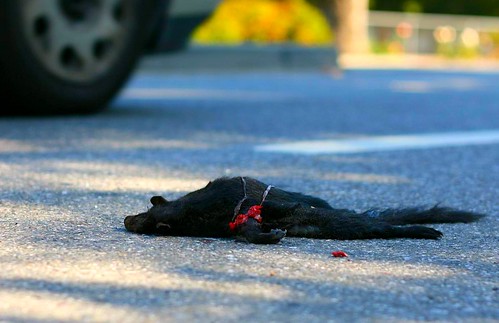
Cartoonish Rick Smith even mentions a couple of roadkill groups on Flickr.
August 5, 200933 Comments on Equipment failure: Bail? Or continue?
I was seven miles into my 25 mile lunch ride along the Bay. I downshifted as I started up a hill; the brifter went “clickclickclick” but there was, oddly, no resistance. I looked back at my rear dérailleur and it was in its smallest cog. I tugged at the dérailleur cable and that’s when the housing popped out of the brifter with the frayed cable poking out. Drat.
I’m riding northeast and I have 10-15 mph winds out of the north along the Bay, with rolling hills. Do I continue my ride, pushing against the headwind in the big gear? Or do I turn around? What decision would you make?
August 5, 200933 Comments on Cash for Clunkers: Contact your Senator TODAY
Please contact your Senator and ask them to vote “NO” on additional funding for the Car Allowance Rebate System (CARS) aka “Cash For Clunkers” program. There are several reasons to cancel this program:
Environment
The CARS program scraps cars by dumping sodium silicate into the crankcase and running the engine until it dies, ensuring the “clunker” is not resold. The idea is that the newer, higher mileage vehicle will have less environmental impact than the clunker.
The top car trade in for this program is the 1998 Ford Explorer, which get 15 MPG and generates about 12 tons of greenhouse gases each year. The Ford Escape Hybrid gets 32 MPG, consumes 11 barrels of oil each year and generates 5.7 tons of CO2 annually. Clearly, there’s a net benefit in GHG emissions after only two years.
Proponents ignore four key facts, however:
(2) When it costs less to drive, people drive more and negate the GHG benefit almost completely. This facet of human behavior is inescapable.
(3) That ’98 Ford is probably somebody’s beater, the truck that’s used on the weekends for trips to Home Depot. It’s impact on the environment is probably already fairly minimal.
(3) 5.7 tons of GHG from the new car is still a lot of greenhouse gas emissions.
In the overall picture, Cash for Clunkers does nothing to benefit the environment. I present an almost best case scenario; realistically, energy analysts figure 0.05% benefit in gasoline consumption.
Economy
The CARS program has clearly benefited automakers and dealerships, some of which report double digit sales growth over July 2008. This is clearly good for them and their employees. Consider, however:
(2) CARS represents a transfer of wealth from the American public to the auto industry.
(3) CARS represents a transfer of wealth from my children and grandchildren to middle aged motorists.
(4) CARS with its destruction of wealth is a perfect example of the “broken windows fallacy.” If one broken window helps the local glass shop, why not break all the windows in town? If Cash for Clunkers is such a “win win” for everybody, why not replace the entire US automotive fleet with brand new cars?
(5) If Cash for Clunkers is such a great idea, why cap the rebate to $4500? Why not $10,000 from the government? How about $20,000? If these cash values are so absurd (and they are), then why is $4,500 okay?
Equity
The inequity of this program is stunning. Cash for Clunkers provides a substantial $4500 benefit to a small portion of the American public, while those most in need of transportation are left out.
(2) The people buying new cars through Cash for Clunkers can mostly afford a new car anyway. The poor are left holding the bag.
(3) Because Cash for Clunkers has removed thousands of vehicles from the used car market, the price of used cars goes up for those working poor who are more likely to buy an older “clunker.”
Many Senators are sitting on the fence regarding Cash for Clunkers, and many GOP Senators are hesitant to oppose Cash for Clunkers because of its popularity. Please contact your Senator right now. The link takes you to a drop down list — select your state and you’ll get a web form to send input to your Senator.
My U.S. Senators from California — Boxer and Feinstein — have already said they’ll vote in favor of Cash for Clunkers, but I wrote to them anyway. Feel free to cut and paste whatever arguments above you think might help your case.
August 4, 20097 Comments on Packers Go Green
Several members of the Green Bay Packers football team rode bikes to practice at their training camp in Wisconsin. Mouse over or click through for details.


