
One of those contentious issues among some transit advocates is the promotion of rail versus bus (and especially Quality Bus or Bus Rapid Transit) for public transportation. I’ve mostly been on the fence about this as an interested bystander who rides both bus and rail, though I probably lean more towards the “bus” argument since I swing conservative as a natural cheapskate.
I’ve seen some interesting discussion lately that just may swing me more towards the ‘rail’ side of things, though.
I’m going to simplify greatly, but the usual arguments in favor of buses revolve around much cheaper capital costs and route flexibility. You can get a bus service going just for the price of a few buses, a barn to house them in, and signs for the bus stops. Light rail projects requires years of planning and public input before you even put a shovel in the ground, on top of the millions of dollars per mile required to lay track and build stations. Even Bus Rapid Transit, which uses right of way reserved just for buses, is said to be much less expensive to build than fixed guideway (aka rail) systems.
Bus transit does have an image problem to overcome, but bus advocates say this is not a function of the transportation mode, but rather the investment a transit agency is willing to put into the bus system. Buses can be just as pleasant, quiet, clean, and fast to ride as any train. Many commuter express services that cater to higher paid office workers have amenities such as free WiFi and coach style seating.

Rail advocates point out that even bus infrastructure has capital costs in road building. Bus rapid transit ridership in the US have failed to meet expectations, while ridership on new light rail lines consistently exceed projections. Rail advocates say building rail is important to build support for transit among the American middle class, who won’t ride the bus (that image problem again) but do ride commuter and light rail systems. William Lind of the Heritage Foundation notes that most rail commuters in the Chicago region, for example, are from the politically conservative suburbs and are vocal supporters of public transportation.
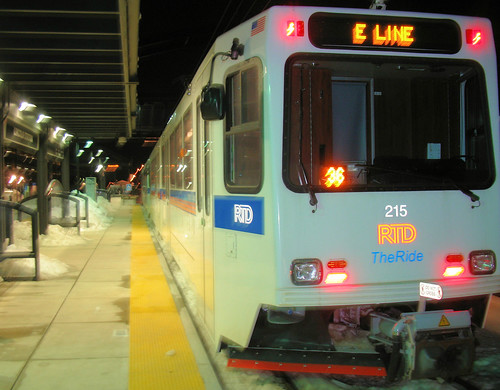
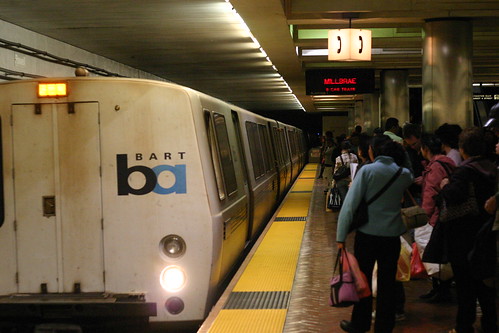
Light rail operating costs can be less than that for buses. One of those extra-long articulated buses can carry fewer than 100 people (uncomfortably), while a typical VTA 2-car light rail train can carry 200. Caltrain has a capacity of about a thousand people per 5-car train. BART can carry up to 200 passengers in each car, and they string them out ten cars long with a single operator.
So there are arguments for both bus and rail, and bus advocates created Bus Rapid Transit as a way to overcome many of the rail arguments.
Cap’n Transit posted what I think is an interesting and important argument in favor of rail, though — the specter of Peak Oil and declining government revenues.
Consider this: Rail vehicles last much longer than buses, and railroads last much longer than asphalt roads. As local governments fail to keep up on local road maintenance, the roads become more potholed, while railroads continue to remain usable for less money. Trains are also cheaper to operate not only in terms of personnel but in energy cost as well.
Cap’n Transit writes:
Those who argue that we should be spending less on capital owe us an explanation for why we should do this while the government is not spending less on car infrastructure. After all, it’s the relative value of transit that will ultimately drive the mode shifts necessary to accomplish most of our goals, and if we stop investing in transit while others continue to invest in roads, the relative value of transit will decline.
The most defensible argument is that we should be investing in transit expansion, but it should be “BRT” (something better than a regular mixed-traffic local bus, to be eternally negotiated downward) and not rail. These arguments clearly ignore the long-term cost of maintenance and operations.
And then we run out of oil, and only the rich can drive. People are left using the transit system that’s built. Which would you rather have: the rail one that will last for years, or the roads that will get more and more potholed as the years go on?
It seems to be a fairly compelling argument for me.
In the SF Bay Area, we have a couple of BRT projects in the works. AC Transit breaks ground on their BRT system through Berkeley, Oakland and San Leandro next year.
VTA plans to implement BRT from Eastridge Mall / Alum Rock, through downtown San Jose along the HP Pavilion and by Diridon Station and continuing down El Camino Real to Palo Alto Transit Center, with about a third of this distance built as a median busway, and the rest as “mixed flow BRT” (in other words, they’re stuck in ECR traffic just like any other bus, though there are enhancements like bus priority lanes at intersections. The Alum Rock segment is planned to be operational by late 2013, with El Camino operational by mid 2015.

VTA also plans BRT for San Carlos / Stevens Creek from downtown San Jose, past Valley Fair, Santana Row and the Apple campus to De Anza College in Cupertino. 3 miles of this proposed 8.6 mile corridor will be a median busway, with the remainder mixed flow. This is along the existing VTA 23 line. VTA 23 currently takes nearly an hour to travel those 8 miles during morning and evening commute times; VTA hopes to shave this to 40 minutes with BRT.
Cupertino has some of the most desirable family housing in the South Bay. Since the state and county are already spending about a bajillion dollars on the Stevens Creek / I-280 / I-880 project next to Valley Fair, it seems this would have been a good opportunity to invest in light rail down this corridor instead.
Your thoughts? For a given highly traveled corridor, would you be in favor of something like BRT or light rail?
why didn’t you talk about how many bikes fit on a bus?
That’s a good point, Ian. 3 at the very most on a bus, vs maybe a dozen on current VTA light rail cars.
My recent take on bus travel here in the Denver Metro area. http://paulswansen.com/?p=1781
My recent take on bus travel here in the Denver Metro area. http://paulswansen.com/?p=1781
My recent take on bus travel here in the Denver Metro area. http://paulswansen.com/?p=1781
Here in Denver bus’s only have racks for two bikes.
Here in Denver bus’s only have racks for two bikes.
Here in Denver bus’s only have racks for two bikes.
The good thing in it all is this. If they are getting dedicated right of ways then in the future it can be changed to light rail. They recently completed this in perth, removing the dedicated busway in the centre of the freeway, and replacing it with a train.
Rail also adds fuel flexibility: You can buy electricity made from coal, natural gas, biogas, solar, wind, nuclear reactors, etc. depending on what’s cheapest and/or more ecological. Changes in bus fuel is limited to rollouts and mid-life conversions which can get expensive.
Rail transit. Definitely rail. The BRT experience I’ve had here in Denver, is that while the bus may get by fine on dedicated bus ways, they still have to eventually mingle with regular traffic, such as getting to/from the bus stations and various stops.
The Light Rail trains on the other hand have their own dedicated right of way the entire way. Delays are rare, and almost never caused by car traffic. Plus, you can fit two bikes on the front car, and four bikes on each of the other car.
Regular buses have room for two, and our regional buses have room for six, but you have to shove your bike in a luggage compartment underneath and let it bounce around on the ride.
I agree with Mike as a fellow Denver-ite. LR is consistent, reliable and has its own right of way. More bikes on rail mean more accessibility for multi-modal. Rail also runs more regularly than a bus route can afford to.
Richard, I agree with you on the perception of bus riding vs. rail. It is especially true on Local routes here in Denver. The longer routes are more comfortable w/ coach style seating (at times), but I would prefer rail most times. Rail investment also means development along the rail lines – Denver metro is a great example of that with new development at many rail stops on our SE line.
I like rail. Some plusses not mentioned are:
* The standard US loading gauge is much larger than the permissible dimensions on the street. This means that rail cars can be bigger in all dimensions and can carry bikes internally, etc.
* Rail cars can have amenities like restrooms, snack bars, etc.
* I have a significantly easier time reading while on a rail line. This is because the starts and stops are smoother in ways that only a fully separated BRT system would be.
On the other hand, and you can use the Hwy 17 express as an example… rubber wheels climb hills better.
At some point in the past, the monorail fanatics (and they are fanatical… even worse than recumbent fans) pointed their brain-ray at me and I decided that uber popular routes like the 22 and 23 really ought to be replaced by monorail lines.
In Dallas, the buses probably have a higher bike to passenger ratio than the trains. I still prefer light rail though.
“Buses can be just as pleasant, quiet, clean, and fast to ride as any train.”
Do you have a single example where this is true? I’ve had a DFW all-area transit pass for nearly four years and have yet to ever find a single case where riding a bus in a multi-mode trip beat either cycling by itself, or combo bike/heavy rail. Light rail is a little better, but not much.
Even heavy rail doesn’t pay for itself around here, though it truly is nice to be subsidized heavily for the Saturday morning trip to downtown Fort Worth for a Starbucks. Still, I’d rather get a direct check and have to ride no further than Euless.
The conservative in ME says make the roads pay for themselves and then let transit companies (like Supershuttle) set a fair market price and a fair market time. I can use my reduced property taxes to make an enlightened choice. People value what they pay market rates for. People abuse what is subsidized. Like roads and public transit.
Hi Steve, I’m repeating the claims of bus advocates, and as you note real
world examples are few and far between. The more expensive commuter
expresses tend to have a higher level of service than your standard city bus
that stops every block.
Sent from my Googaw
I think a mix of both is necessary. Rail is quicker, more pleasant and better supports multi-modal transport Buses have route flexibility and can reach more people more easily.
Don’t leave out Subways – faster than pokey light rail. Longer lasting, hold more people. Cost more.
Here in Los Angeles we have the 30 mph Blue & Gold line vs the 60mph Red line. There’s quite a difference. The Subway is below ground where it has a pretty direct right of way. The street level light Rail has well… streets to cross, which means peds, cars, and bike to collide with.
Either is a more substantial option than buses. And you can get bikes into rail. Not so easy with a bus. Rail is much more multi – mode transportation.
I’m intrigues me and I’m still on the fence about the cost issue. Just how much bus and road maintenance would we get for the equivalent of a 5 billion dollar light rail line? Maybe 1000 buses and a dedicated concrete roadway for them? That’s a lot of bus. In eany case, I can bike the 15 miles faster than the expected travel time of either!
Eric W
Since i’m down here in San Jose now, I might have to start a ‘bikes, not buses’ campaign here, and let SF fend for themselves.
I honestly don’t know why anyone would advocate for bus service, but that’s up to each individual — I just don’t want to see any more time/money/effort/space given over to motorized transport, be it car, rail, bus, whatever, at the expense of walking and biking. We need to be able to walk and bike on the major corridors, especially the major corridors — handing over even more space to motorized transport before we even get the minimum amount of infrastructure required to support walking and biking these corridors is unfair/insane/etc.
I feel like in the Bay Area we often get investment in rail where it suits the whims of politicians and planners, and then agencies scramble to throw together BRT to serve actual transit needs with whatever money is left over. So Muni built the T line in 3rd St, and is planning BRT for Geary. VTA built light rail from East SJ to downtown via Milpitas because (I really can’t figure out why, actually!) and is planning BRT on the direct, many-miles-shorter route straight between the eastside & downtown.
I’ve thought sometimes that it would be a good idea to build BRT first (and all over), and then upgrade the best-used lines to light rail later.
I think this would get people to concentrate on things that make transit successful, regardless of what kind of wheels it rolls on —
– Keeping vehicles from getting stuck in regular car traffic (use dedicated lanes where it’s most needed)
– Making a streetscape that supports transit
– Making sure the lines really go where people really want to go (duh!)
VTA is figuring out they built LR lines in the wrong places. If they had built BRT first, they could tinker with the lines a bit, and then lay rail.
Buses offer more flexible route structures and that is also a major problem as routes are often changed… then there are all those traffic delays, pollution, capacity limits, etc. And of course they are dangerous to cyclists and pedestrians and make way TOO MANY stops.
Both rail and buses are needed, but having ridden both for over 25 years, light rail offers greater predictability, speed and capacity. It’s time to convert the extra (those over 4) highway lane to facilitate train and bus routes.
@Peter wrote: I honestly don’t know why anyone would advocate for bus service…
A number of bus riders in the Bay Area sued our regional MTC for allocating transit funds unfairly, alleging the MTC discriminates in their funding decisions that allocate much more money to rail transit (read “BART”) than to bus services because rail transit is used more by affluent whites, while people of color ride the bus. Yesterday, the US 9th Circuit affirmed a 2008 lower court decision in favor of MTC.