Author: Richard Masoner

North Carolina: Bicycle is a 19th century solution

North Carolina congresscritter Patrick McHenry: 19th century technology no solution to energy woes.

On my bicycle commute in high-tech Silicon Valley, California, I see up to 100 other bike commuters every day, most of whom are employed as chip designers, rocket scientists, robot researchers, high-energy physicists and biogenetic engineers. The biggest employer in North Carolina 10th District Congressman Patrick McHenry’s home in Catawba County, on the other hand, is the “retail trade” sector. Yep, the highest tech they have is the point-of-sale system at Burger King.

Streetsblog reports on North Carolina Congressman Patrick McHenry, who said regarding pending energy legislation:

The Democrats’ answer to our energy crisis is, hold on, wait one minute, wait one minute, it is promoting the use of the bicycle.

Oh, I cannot make this stuff up. Yes, the American people have heard this. Their answer to our fuel crisis, the crisis at the pumps, is: Ride a bike.

Ladies and gentlemen, I bring you the Democrats, promoting 19th century solutions to 21st century problems. If you don’t like it, ride a bike. If you don’t like the price at the pumps, ride a bike.

Streetsblog implies and commentors note that the automobile and the internal combustion engine is also 19th century technology, as are lightbulbs, phones, radios, railroads, guns, photography, refrigerators, stethoscopes, and even paved roads! Many modern bicycles, in fact, require advanced technologies, materials and manufacturing processes that did not exist in the 19th or even 20th centuries.

McHenry is probably buddies with Dr. David Hartgen, emeritus professor of transportation and the University of North Carolina Chapel Hill who writes policy papers for the John Locke Foundation. Complete Streets advocates such as senior citizens and paraplegics, Hartgen says, “It’s really just arrogance and selfishness on the part of usually very small groups of individuals. They exert political power to ‘take back the street,’ but the street is not theirs to take back.”

Professor Hartgen needs a history lesson: The streets have always belonged to all the people. Longtime New Mexico bike commuter Khal Spencer is quoted in a recent edition of CenterLines from the National Center for Bicycling and Walking:

Our roadways have always been designed with the intention of being shared by multiple users. A road is simply a paved structure meant to accommodate a given width and weight of vehicle. The first paved roads were in fact lobbied for by bicyclists in the last part of the nineteenth century and were later shared by early automobiles. Since then, a myriad of ‘other’ users including Amish buggies, farm equipment, bicyclists, and other slow-moving vehicles have legally shared the road with motorists. While that has undoubtedly required the occasional patience and understanding, it has always been considered a mark of good citizenship to responsibly share the roads. The present animosity between a small fraction of cyclists and a small fraction of motorists is more personality driven and should not detract from the safe interactions among most adult drivers and cyclists.

The rise in popularity in cycling has indeed given rise to an equally popular cyclist’s lobbying movement to incorporate cycling-specific design into new roadway construction or renovation. While there are differences in details among various special interest groups, what virtually everyone, whether motorized or not, agrees on is to provide added width (shoulders, bike lanes, wide traffic lanes) so that cyclists and motor vehicles traveling at different speeds can get past each other without encroaching into oncoming traffic. However, while such improvements are wonderful, they do not detract from our present roadway’s ability to be shared safely by competent, compliant users.

North Carolina cyclists, you can let your Representative how you feel about your “19th Century technology” by calling him at 202.225.2576 in Washington DC, or toll-free in North Carolina at 800-477-2576. More contact information is on his website. 10th Congressional District residents and businesses can contact him via the web here.

Please remember to click the Digg and Cyclecluster buttons below if you like this article!

Guy Kawasaki Trek factory visit

Silicon Valley Venture Capitalist Guy Kawasaki blogged about his visit to the Trek factory in Waterloo, WI.

THe photos are kind of cool, with pictures and details of various Tour de France winning bikes. He also shows us the bike garage, assembly area, and other pieces of the Trek factory.

More interesting to me are Kawasaki’s vignettes of life at Trek.

There is quite a bit of testing done at lunch. It can take up to two hours or more sometimes. After all, testing is important.

Trek staff heads out for the evening commute. Employees make good use of the commuter program. Each day someone rides, walks, skates or car pools to work, that employee receives credit for Trek products or cash for the cafeteria. This is an incentive to keep in the latest gear and promote general wellness. Between the commute to and from work and the “Lunch Time Ride” my friend at Trek used to average 50+ miles a day during the summers.

Trek factory visit by Guy Kawasaki.

Ride a bike to win a prize!

Carbon Conscious Consumer Logo

Click on the logo to win a one week bike tour in Oregon, a Breezer Bikes Villager bicycle, or a t-shirt and $200 in carbon offsets. All you have to do is pledge to avoid driving a car one day each week.

Carbon Conscious Consumer (C3) is a national climate campaign sponsored by the Center for a New American Dream that challenges individuals to establish climate-friendly daily habits and inspire their friends to do the same. Click here to make the pledge and enter the contest.

Bicycle projects galore

Since the end of the Tour de France I’ve been catching up on my day job. Here are several bike projects that should keep you busy for a while.

Yahoo’s company car


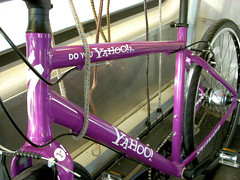
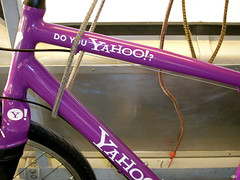
“The limited edition Yahoo! bike” photo from Yodel Anecdotal.

Yahoo held a huge bike fair at their Sunnyvale headquarters last week. The bike fair was organized to encourage bicycling as transportation. Specialized, local bike shop Mike’s Bikes and the Silicon Valley Bicycle Coalition were on hand to display bikes and help people with bike commute routes.

Five lucky Yahoo employees also won a special Yahoo edition of the Specialized Globe Comp IG8 bicycle. The Globe Comp IG8 is a commuter bike with Shimano’s Nexus 8 speed hub in the rear wheel, carbon fiber front fork with fender mounts, and 700×42 flat resistant street tires.

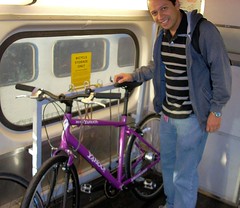
Yahoo special edition from Specialized

That purple bike is pretty hard to miss; I ran into one of the lucky winners — Daniel — at the Caltrain station in Mountain View, California last night and learned about the Yahoo bike fair.

Cleantech blog notes that Yahoo! is among the most successful when it comes to encouraging Yahoos to use alternate means of transportation:

36% of Yahoo headquarters employees get to work without driving solo. This is double the 18% mode-shift that the corporation committed to the City of Sunnyvale when building permits were first issued. Yahoo’s cool commute program is comprehensive, popular and getting results.

Yahoo provides employees with free VTA Eco-Passes for bus and light-rail. Many of the Yahoo commuters are able to get extra work done using laptops and other mobile devices while commuting on public transit.

Yahoo’s results are impressive considering that Silicon Valley workers are widely dispersed in search of affordable housing. Technologists work long and irregular hours, which makes ridesharing more challenging. Many Silicon Valley locations provide a long and uncomfortable walk in the dark to public transit.

Yahoo addresses these problems in a number of ways. One is that it provides a guaranteed ride home. Yahoo will pay for a late worker’s taxi or rental car. Many at the workshop agreed that a guaranteed ride home is critical to a commute programs success. All agreed that employees rarely use the guarantee, making the cost minimal.

Yahoo has a fleet of shuttles to get people to and from transit, between Yahoo locations, to airports and sometimes providing an emergency ride. Some of the shuttles run on B20 biodiesel.

It is not easy to get employees to change their commuting behavior. Yahoo used surveys, education, an intranet website to help people find others for ridesharing, and YahooGroups to encourage collaboration, and monthly reward competition for those who avoid driving solo.

Yahoo encourages the use of the zero-emission vehicle owned by one billion people on this planet – the bicycle. Yahoo provides bicycler riders with secure storage of their bikes. Free lockers and showers are available. To help people quickly navigate Yahoo’s campus of buildings, loaner bikes are also available.

Please remember to click on the Digg and CycleCluster buttons below if you like this article!