
My parents are safe and well at their home in Rokunohe, Japan.
My parents live about three miles from the Pacific coast in northeastern Japan, about 10 miles north of Hachinohe, and about 100 miles north of the hardest hit regions in Miyagi Prefecture. Rokunohe is a small village on farm land just south of Misawa, Japan.
Japan is divided into 47 “prefectures.” That’s the word we generally translate into English from the Japanese todōfuken (都道府県). The prefectures are self governing areas larger than cities that are analogous to provinces or states. Each prefecture has an elected governor and elected single house legislature.
Most prefectures are denoted with the suffix -ken. The largest tsunami damage occured near Sendai in Miyagi-ken, or Miyagi Prefecture. My parents live in Aomori-ken in the town (machi) of Rokunohe.
Internet was restored on Saturday in his neighborhood and my dad emailed immediately to let me know all is well. Freezing temperatures and snow combined with the lack of power and fuel deliveries compound the misery of the survivors, but my dad says his 3kW photovoltaic panel and solar water heat have kept things comfortable at home. My parents also have a week of water, canned food and other supplies, and they’ve been cooking on a big Coleman camp stove using his stash of Coleman fuel.
He writes that personal sanitation is a problem for many of his neighbors: you might have enough drinking water, but water for bathing (especially hot water) and flush toilets is in short supply in this fastidious culture.
My dad also writes, “All the local gas stations are dry. Feet are always reliable.”
Misawa Air Base
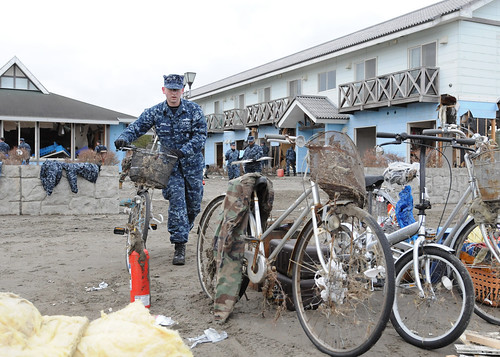
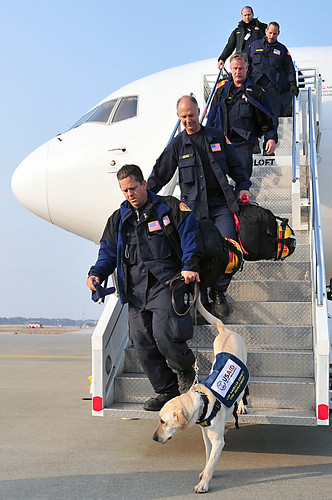
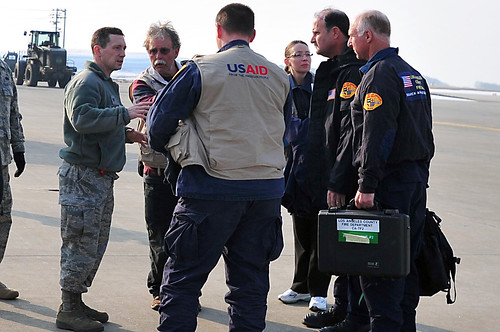
Rokunohe is just south of Misawa Air Base, a joint U.S./Japan military installation and one of the few operating airfields in northern Honshu right now. American search and rescue teams fly into Misawa and stage their efforts from there. Sailors, soldiers and airmen from Misawa are helping out with recovery efforts in their area.
![Sailors Continue to Aid with Recovery Efforts [Image 1 of 14]](http://farm6.static.flickr.com/5012/5528733819_4c9591d3a5.jpg)
I saw a familiar name in the news. The American wing commander at Misawa, Colonel Mike Rothstein, appeared on the Japanese news. Mike and I were friends in high school at Yokota Japan but went our separate ways during the college years. I heard he flew jets but had no idea he was commanding a military base these days.
Misawa and nearby Lake Ogawara, incidentally, is where Japanese Imperial Navy aviators practiced their Pearl Harbor surprise attack. The U.S. 5th Air Force subsequently bombed the base and adjacent Misawa City (my mother’s hometown) into splinters during World War II, destroying 90% of the structures there. My Japanese grandmother, mom and her siblings spent the war hiding out in a cave, while my American uncle Bill Masoner became a Navy flying ace flying Hellcats over the South Pacific.
Oh, and my old man? He’s nearing 70 years of age and he’s volunteering with recovery efforts by translating for the English-speaking search and rescue workers. I’ve mentioned in the past that he spends his winter weekends climbing nearby snowbound mountains, so he should be fit enough to hike through the muck of devastated coastal Japan.
Gottfried and Beck
Many of my Japanese friends and some of my family in Japan are cracking jokes way more offensive than what Gottfried tweeted. Maybe they (and I) have the right to do that since we’re a little closer to the tragedy than most, but man, you’ve got to lighten up or this stuff will make you go crazy.
I can’t generally stand Beck, but his remarks about God or Gaia using the quake as a message doesn’t strike me as particularly shocking either. It’s not any different from the message of Godzilla in 1954, or to some speculation claiming a tie between the quake’s damage to global warming.
With a shoutout to Johan, an Aussie expatriate in Japan who helped me get information from Aomori, and Tokyo By Bike, who is focusing on the important things right now.
Good to know the family is ok.
Very glad to hear that your family is ok and doing well.
Good news that your family is OK. I gather everyone there will be extremely busy for a long time… and then there are those ongoing dangers from Fukushima D reactor.
Glad to hear your family is okay. Was a bit worried because I know they are from Aomori. My family is southern so they are mainly dealing with the collapse of the communication and other infrastructure in Japan.
please send my best to your Dad and Mom from Matt at Cisco, I am glad all is well with them.
What a relief eh? We’ve been checking in regularly, hoping for good news for you. Very glad to hear they’re OK.
It’s good to hear that Rokunohe was spared from major damage. Do you have any information about Oirase? I spent a year in high school at Momoishi kotogako from 1978-9 and am concerned about some of the people I knew there. After seeing the damage in Hachinohe, any info would be wonderful.
Doug Hormann
It lifts the spirits to hear good news from Japan right now, in light of the multiple disasters, and the media coverage of those disasters. Best wishes to your family and friends, Richard, and thanks for this positive post.
On another blog somewhere (Urban Country?) I already congratulated your father as being one of the angels in the ’95 Kobe earthquake, bringing supplies in by bike. And good habits die hard. I am not sure if your father has bad luck for being near both quakes, or good luck for surviving both, but if he is Buddhist he’s an incarnation of a boddhisatva for certain.
Great news that your parents are safe after not knowing for so long.
Glad to hear your parents are OK. You were the first person I thought of when I heard about the earthquake/tsunami. On a side note you father sounds like he’s amazingly prepared for just about any disaster: Earthquake, Tsunami, Zombie Apocalypse…
Glad to hear your parents are OK. You were the first person I thought of when I heard about the earthquake/tsunami. On a side note you father sounds like he’s amazingly prepared for just about any disaster: Earthquake, Tsunami, Zombie Apocalypse…
Hey all, thanks for the comments. They really mean a lot.
Do you happen to know anything about the conditions in Momoishi-machi? I was a JET teacher there years ago and haven’t been able to get any information.
Great to hear that your parents are safe.
Good morning!
I am Brazilian and my name Kioshi Matuchita, I worked some years in nippon food packer in Momoishi – machi – Aomori-ken and I’m very worried for my friends who still work there. I have friends from Brazil and Japan and would like to know if something happened to them after the earthquake and tsunami. I can not hear from them here in Brazil. Please can you give me some information!? Thank you and good luck!
Hello, my name is Joyce Smith. My father, Senior Master Sergeant Leonard G Blair, was in the security service during the ’60s and we were stationed at Misawa from ’65- ’68. I was in high school then and met my husband there. We now live in Missouri. Three days before we left, in May of ’68, there was an 7.4 earthquake north of Misawa. It did quite a bit of damage to the house we lived in. There were cracks from one corner of the house to the opposit cormer, It separated our concrete front porch and sunk it 6 inches into the ground. It was a very frightening experience. So I can imagine how your parents and all the people there could have felt. My prayers have been with them all since this happened. I’m so glad I found this site so that I could comment here. I went to the map site online of the base and it sure brought back a lot of wonderful memories. I will continue to pray for your family and all the others there. Thank you.
My name is John Cox, I was stationed at Misawa.Japan I was attached to the 8th Fighter Squadron (BLACK SHEEP) I left Misawa Air Base and returned to the good ole USA to Sewart AFB Tn (now Closed) I retired from the Air Force in 1970, Anyone wishing to contact me please do if you were stationed at Misawa, I love the Japanese people and I get to chat with students at the local college here in Tennessee, Please contact me at Mailmancox@Bellsouth.Net CMS John Cox Retired. 3/2412