Author: Richard Masoner

UK Cycle Show 2007 photos

Carlton Reid has attended Cycle Show 2007 in London, the “UK’s greatest cycling show” featuring a high energy fashion show and (of course) more bike stuff than you can shake a frame pump at.

You can view Carlton’s photos from the UK Cycle Show here at Picasa, or view a slideshow accompanied to some cool music here at YouTube.

UK-based BikeRadar also covers news from the UK Cycle Show here and here and here.

Singletrack World also reports on the world of British mountain biking at the London Cycle Show here. Singletrack World blog entries about the show are provided by Mark and Chipps, who writes about “many shiny distractions.”

The Guardian provides the mainstream media spin on Cycle Show.

Bicycle news for mobile devices

I just ran across this Cyclelicious Mobile Widget from Plusmo. The Mobile Widget is a piece of software for your cell phone or other mobile device that sends Cyclelicious content to your phone, automatically.

I’m not a user of small mobile technology — in fact, my cell phone died about 3 weeks ago and I have yet to replace it. I know of at least one regular reader who does much of his blog reading on a mobile device. What should I do to make Cyclelicious friendlier to cell phones and similar mobile gadgets?

Sheldon Brown’s Interbike 2007 report

I looked for Sheldon Brown at Interbike. I did see him across the way once, but he was whizzing away on his electric scooter and he disappeared.

I missed this earlier, but Sheldon posted his own Interbike 2007 updates at his website. He notes the trend toward commuter bikes, especially high end expensive commuters bikes, and he likes what he sees.

Sheldon highlights a handy-dandy emergency derailleur hanger from Wheels Manufacturing that might have come in handy when I trashed my hanger. But then again maybe not, since I also destroyed the rear derailleur and my chainring bolts.

There’s lots of good stuff at Sheldon’s Interbike 2007 report. Give it a read when you have the chance.

San Francisco zombie alert!

The Eerie Early Warning System has detected a sudden upsurge in potential zombie activity, according to San Francisco Zombie Mob:

With Professor Grenzfineski’s assistance, a zombie homing beacon has been hastily assembled and installed at the Main Library’s north-western corner on Larkin Street, by Fulton.

This device will be switched on TOMORROW night, Thursday the 11th, at PRECISELY 7:30pm. Once activated, the undead hordes will be unable to resist its pull, and will gather immediately at its base, where we will attempt to neutralize them before they can once again terrorize our fair city.

NOTE: Great care must be taken with this operation, as a San Francisco Mayoral debate will be taking place in the Main Library. If we are unable to contain the zombies, it is highly likely that they will turn their attention to the hundreds of citizens exiting the debate at 7:45, whom, though disenfranchised, are not disembrained, and may thus prove irresistible to the shambling cerebrophiles. (Thankfully, zombies DO NOT attack or otherwise harass innocent bystanders. Their moans and sheer numbers are more than horrifying enough.)

Go here for the gory details.

Contest: Thank you to those who have entered the StreetView contest! Don’t forget to enter if you haven’t yet.

Traffic lights and bicycles: The technical explanation

California Governor Arnold Schwarzenegger recently signed AB 1581 into law, which requires all new traffic actuated signals to detect bicycles and motorcycles after Caltrans adopts uniform standards, specifications and guidelines for these kinds of traffic signals.

Traffic engineer Bob Shanteau is an avid cyclist and active cycling advocate. He will present this paper on “Detecting Bicycles and Motor Vehicles Using the Same Loop Detector” next Tuesday at the state capital on the detection of bicycle traffic using inductive loops. Bob has asked for input on his paper; if you have any constructive feedback, please feel free to email him or comment here. He also plans to publish this as an article in WesternITE, the newsletter for the Western Region of the Institute of Transportation Engineers.

The paper is somewhat technical, but describes in great detail how the various inductive loops work, the challenges of various designs with respect to cyclists and where we ride, and his experiments with new designs in the city of Monterey, California.

I’m looking forward to seeing Bob’s recommendations translated into state guidelines for traffic signal actuators that work well with bicycles.

How loop traffic light detectors work

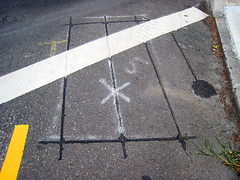
Loops of wires are embedded in the road surface. You can often see the saw cuts where the wires are installed at intersections. An electrical current passes through the loop, creating a magnetic field. When a conducting object — such as a car, motorcycle, or bicycle — intersects this magnetic field, electrical currents are actually created within the metal object. This electricity in turn creates its own magnetic field in the opposite direction from that created by the loop, resulting in decreased magnetism. When the magnetic level drops below a preset threshold, the actuator is tripped.

If the threshold is too low, traffic in adjacent lanes can trip the actuator and incorrectly trigger a signal light change. Unfortunately, this threshold is often too low to detect bicycles and even motorcycles. In his paper, Bob makes recommendations for inductive loop configurations, loop placement, markings, and engineering practices for setting threshold levels.

Photo Credit: “I’m Going To Be An Actuator” by Hen Waller. Creative Commons “Some Rights Reserved” license.