Author: Richard Masoner

San Jose to Palo Alto bicycle commute

Bay Area cyclists who’d like to join me on my morning commute Friday morning: I’ll be taking off from San Jose Diridon Station at 7 a.m. Look for me as I hop off of the Highway 17 Express bus. I ride a silver Specialized Roubaix. The mornings have been chilly so I’ll wear my yellow cycling jacket. But then again every Bay Area bike commuter wears a yellow jacket…

Scot will also be there on his black and red Specialized S Works Tarmac. We’re headed to Palo Alto via Park, Monroe, Benton, Homestead, Foothill, Page Mill and Bryant. We ride at about a 17 mph pace until we hit Foothill Expressway, then it’s 20 to 30 mph all the way to California Avenue in Palo Alto. We stop for all reds, and stop for traffic at stop signs. This is a fast ride but it’s not a mano y mano painfest and we’ll hold back if necessary for slightly slower riders.

There’s no need to contact me — just be at Diridon Station at 7 a.m. when we leave. This is a regular ride so I’ll try to be a little more organized next week if there’s some interest.

Good life cyclist

Mike the cyclist commutes 24 miles from Centennial, Colorado to Lakewood. He recently started spreading the good word about cycling on Good Life Cyclist, where he shares all things good about riding a bicycle in Colorado.
Mike enjoys mountain biking in the foothills of the Rocky Mountains. “I call the foothills my backyard playground,” he writes. “From my house I can ride 20 to 30 minutes and explore Green Mountain, Red Rocks Park, Mount Falcon and Lair Of The Bear. I loop these all together for a 40 mile training ride.”

Regarding his commute, Mike writes, “I love it – this is my main way to get in the training hours while still doing something I have to anyway (get to work) and saves gas, wear and tear on the car. However the money I have been spending on bicycle gear might balance out the gas savings.”

What is he training for?

My main cycling goal right now is to train, prepare and finish the Great Divide Race in 2008. The Great Divide Mountain Bike Route (aka GDMBR) was put together by Adventure Cycling and is the longest off-pavement bike route in the world. It crosses the continental divide a total of 27 times. Its total length is 2,490 miles starting in Montana at the Canadian border and finishing in New Mexico at the Mexican border.

The route is the longest and most challenging off road bicycle tour in the world. It is the Holy Grail of the mountain bike world. My goal is to complete it in under 20 days. The record is 15 days 4 hours and 18 minutes. Only 5 people have ever completed this in under 20 days.

Mike, as a television commercial producer, plans to record his experience of the Great Divide Race 2008 and produce a documentary. Check out Good Life Cyclist.

Gasoline makes you fat

Santa Cruz Highway 1

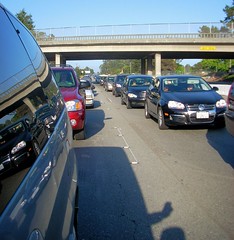
Here’s an interesting study [PDF] from Washington University in St. Louis in which economist Charles Courtemanche demonstrates a causal relationship between the price of gasoline and obesity rates in the United States. According to this study, an additional $1 in real gasoline prices would reduce obesity in the U.S. by 15% after …five years, and that 13% of the rise in obesity between 1979 and 2004 can be attributed to falling real gas prices during this period. Courtemanche provides evidence that increased gas prices will result in more exercise for Americans as well as fewer restaurant visits. He writes:

If the price of gas rises, the cost of driving also rises, which may affect body weight in two ways. First, people may substitute from driving to walking, bicycling, or taking public transportation. Walking and bicycling are forms of exercise, which increase calories expended. If a person uses public transportation, such as subways, buses, trolleys, or rail services, the need to move to and from the public transit stops is likely to result in additional walking, again increasing calories expended. Second, since the opportunity cost of eating out at restaurants rises when the price of gas increases, people may substitute from eating out to preparing their own meals at home, which tend to be healthier. Income effects may also lead people to eat out less in an effort to save money to pay for the increased cost of gas.

Courtemanche notes that the reduced obesity rates can save 16,000 lives and $17 billion per year in health costs, partially offsetting the pain of paying higher gas prices.

Props to Tim Grahl for this news.

Other news:

Mass market fixed gear bike

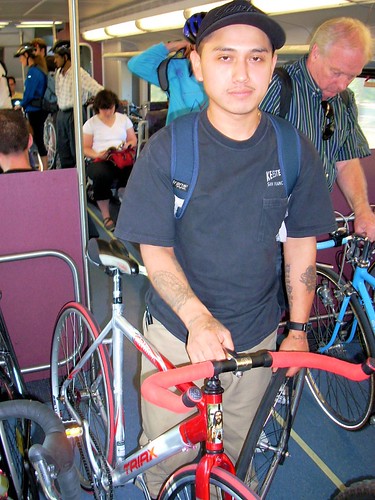
Triax is a brand of Dynacraft bicycle sold at Target stores in the United States. Retail price is $150 but it’s often on sale for half that, and you can find them at flea markets for even less.

It’s a junky, ugly road bike, but if you’re looking for something cheap and functional it’s not a bad bike to commute on. The only problem is that the components are cheap junk. They’re difficult to keep adjusted, but if the components fail or fall apart, the dérailleur hanger is long and nearly horizontal, making the Triax Crimson road frame a decent platform for a fixed conversion on the cheap.

Carlos and his fixed Triax

Carlos here converted his Triax bicycle to fixed gear. I love the Jesus picture in place of the headbadge on this bike.

Because the components on a Triax are so junky, converting to fixed is probably a good idea. Upgrading the wheels and tires and replacing the drop bars with those bullhorns makes the bike a little cooler, though it’s probably overkill. Those bars are possibly worth more than the frame. The wheels certainly are. Carlos rides brakeless with flat platform pedals.

Carlos doesn’t speak English; I was surprised to see a recent immigrant Latino riding a fixed gear bike. In the Bay Area, many “fakengers” (like me) are comfortable white people with steady income.

Carlos obviously has some pride in the bike and he told me he built it up himself. I imagine the frame was probably acquired used with non-working components.

Those in the San Francisco Bay Area will recognize this photo was taken on a Caltrain bike car during the evening commute. Almost every person in this photo is a bike commuter.

Freedom

I had a post in mind about 9/11, terrorism and American liberty, but it’s a busy day week at work so I’ll point you to this old article on Freedom from Citizen Rider.

They hate us because we are free. They hate us because we question the beliefs they hold so fervently. They hate us because they think we don’t belong in their country.

Assuming that their way of life is the one true path, they deem us infidels, lesser beings who deserve to be destroyed.

They can’t stand freedom. Having given it up themselves, it irks them to see anyone else have it and use it. They create a whole value system based on the necessity to be like them and deprive ourselves as they do.

Read more.

Bicycle risks and safety

Raise The Hammer in Canada posts a good article about the safety of bicycling relative to the risks of other common activities such as driving and walking. The author, Ryan McGreal, uses real numbers and everything!

The fatality rate for every million hours spent cycling is 0.26, compared to 0.47 per million driving hours (on-road motorcycling comes in at a whopping 8.80 deaths per million motorcycling hours). For every million cyclists in the US, 16.5 die each year, whereas for every million motorists, 19.9 die each year.

Another way of evaluating risk is to examine the odds of dying if you do crash. The odds of dying from a bicycle crash are one in 71. This compares to one in 75 for a light truck (pickup truck, SUV, van), one in 108 for a car, one in 43 for a truck, one in 26 for a motorcycle, and one in 15 for a pedestrian.

In other words, the odds of dying in a bike crash are about the same as the odds of dying in an SUV crash. The false sense of security that comes from an SUV tends to produce far more dangerous driving behaviour.

The author discusses risk quite a bit more and talks about commute homeostasis and the factor of improved health of cyclists, but in the end he concludes that cycling is a relatively safe activity.

Part of my mission at Cyclelicious is to note that bicycling is a safe activity. There’s a perception among too many that bicycling is a dangerous activity — it seems counterintuitive that sitting exposed in traffic on a bike is about as safe as riding inside of a metal cocoon. McGreal makes an important point in his article that our riding behavior can have a significant impact on risk. Following the rules of the road and an educated awareness of traffic risks reduces the risk of injury collisions significantly.

If you want to be a safer cyclist, read Ken Kifer’s archived information on bicycling safety. I recommend the book The Art of Urban Cycling by Robert Hurst, which is good for all kinds of city cycling, not just downtown urban cores. I also recommend the League of American Bicyclists bicycling education courses for instruction in safety and bike handling skills. Even if you’re an experienced cyclist, you can learn quite a bit from taking the LAB classes.

A hat tip to Paul Dorn for pointing to the risks article. He also posted good commentary on motorist advocacy in Seattle.

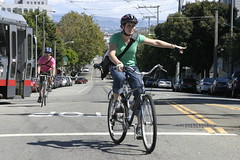
Photo credit: “Hand Signal” from San Francisco Bicycle Coalition.