Author: Richard Masoner

Tax credit for exurban car commuters

Hey America, did you know that we’re at near record low gasoline inventory levels in the United States? What do you do when you’re running short of a declining resource? Do you carefully husband the resource so it will last as long as possible? “No!” proclaims Congresscritter Zack Space of Ohio. “Let’s pass money around so we can use it up even faster!”

I announced my plan to introduce the Rural Commuters Tax Relief Act of 2007. This legislation could not be simpler: If your household makes less than the national median income, you drive more than 30 miles to work and you work at least four days per week, then you receive a $100 tax credit for each month that the average price of gas is more than $3 per gallon.

The U.S. household median income in 2006 was $48,200. If you’re married filing jointly with two children, you can easily find enough deduction to bring your federal tax burden to less than $3000. With this tax credit you can chop your tax bill nearly in half!

It’s nice that Mr. Space is pulling for the little guy, but I and others have been warning for years that the affordable house out in the exurban prairie won’t be so affordable once oil prices start the inevitable climb right about now.

Read Zack Space’s opinion piece here. You have to wonder what they thought on Easter Island when the last tree was chopped down.

Bike lane passing lane

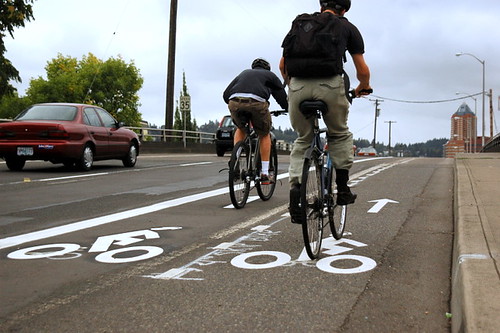
These passing lanes in the bicycle lane in Portland are kind of cute:

The new markings include side-by-side bike lane symbols to denote the passing lane and skip-striping both where the lane widens (and then narrows) and to separate the slow and fast lanes. The new striping was done to facilitate easier and safer passing on an uphill portion of one of Portland’s most congested bikeways. More info at BikePortland here and here.

Bicycle blog bicycle news

BRaIN gives a nice overview of “yellow bike” rental schemes (historical, proposed and real) in Paris, Chicago; San Francisco; New York; Washington, DC; Portland, OR; and even Lexington, Kentucky. The Bike Sharing Blog covers this trend in detail.
Bicycle Commuter

Thunderhead Alliance released their first benchmarking report detailing the level of bicycling and walking in the United States. According to the Thunderhead Alliance, the main findings of this report are:

  • A positive relationship exists between the built environment and levels of biking and walking.
  • Where levels of biking and walking are higher, bicycle and pedestrian safety is greater.
  • Cities with strong Thunderhead organizations generally have high levels of biking and walking.
  • Higher levels of biking and walking coincide with lower levels of obesity, high blood pressure and diabetes and higher levels of adults meeting recommended levels of daily physical activity. This suggests that increased biking and walking would contribute to a healthier society.
  • Data revealed that while some cities and states lead others as models for bicycle and pedestrian policies and provisions, all states and cities have a need for improvement.

Volunteers needed for bicycle and pedestrian counts in Minneapolis. Details at Velocipete.

Sister Julie is a Catholic nun who blogs about bicycling. It’s kind of fascinating. For one thing, I had never seen a nun in bike shorts before. Via Bicycle Champaign-Urbana.

Grist details the differences between the U.S. House and Senate versions of the 2007 Energy Bill. I’ve mentioned previously that the BIG difference of interest to cyclists is the House version contains a provision for a bike commuter tax benefit, while the Senate version does not. Contact your U.S. Senator and ask them to support inclusion of Bike Commuter benefits in Senate Bill 1419, the “Renewable Fuels, Consumer Protection, and Energy Efficiency Act of 2007.”

MAKE: a bike powered by a portable electric drill.

Utility Cyclism: Appropriate bicycles for utility cycling.

Iowa announces Safe Routes to School program.

Beverly Hills cops blame the victim. The way the cops treat cyclists there is infuriating. Beverly Hills holds the dubious distinction of being #1 in the State of California for pedestrian deaths for a city of its size. Via Industry Outsider. Oh, and LAist used a photo by Yours Truly.

People oriented cities are cycling friendly cities.

Watch this space for Interbike 2007 news in a couple of weeks.

Bicycle girls of New York

Here’s a cute article in the New York Observer about bicycles as fashion accessories:

Vikki Eichmann was striding through the Union Square farmers’ market, one hand steering a sea-green, 1970’s Schwinn Breeze bicycle and the other tossing a curtain of silky brown hair over her bony shoulder. She was wearing a strapless plum-colored sundress and $400 Cole Haan knee-high boots. “They’re perfect because they’re sturdy and I don’t get scratches or bruises from the bike or anything,” Ms. Eichmann said, stopping to pick through a crate of peaches. “Plus they just plain look cute on a bike.”

BikeSnob NYC gripes about these “beautiful Godzillas” on 2 wheels — it reminds me of the 90s when anybody with a dialup account could get Internet access and all of the old timers (like me) griped and complained about the mass market availability of the Internet — but I like that urban trendsetters are using bicycles to get around.

Ms. Rose’s first adult trike was purchased on eBay; her second custom-built by one George Bliss, owner of the Hub Station on Morton Street, who specializes in pimping rides for the new set of beautiful bicycle girls. “Lela shows that you can carry a load on a bicycle and look glamorous,” Mr. Bliss said. “She’s really inspired me, and now I’m focusing on the tricycle child carrier as a product for upscale women in SoHo. … That’s the niche, professionals and models because, you know, if you go to a cocktail party, you’ve got to have something to talk about. ‘Green? What’s green? Oh, bicycling!’

“Women are our best customers,” Mr. Bliss continued. “They know what they want. That’s all that really matters.”

Read more in the New York Observer.

New York City Traffic Commissioner bikes to work

Janette Sadik-Khan, the commissioner of the Department of Transportation, rides her bicycle to work. That the head of an agency long associated with car travel is an avid bicyclist symbolizes what might be a new way of thinking about how New York’s asphalt should be used.

Ms. Sadik-Khan said her time on two wheels has become an important part of her work.

“It’s invaluable to get on a bike and see firsthand the conditions that our projects are trying to address,” said Ms. Sadik-Khan, who became the city’s transportation commissioner in the spring. “We are really emphasizing connectivity in the bicycle lane network, because all cyclists, myself included, know that it’s maddening to be coming along a lane and have it simply end and leave you off on your own on a big avenue.”

Read more in the New York Times: To Ease a City’s Traffic, Shifting From 4 Wheels to 2.