Author: Richard Masoner

Titanium fender from Honjo

Honjo Koken hand fabricates 20,000 metal fenders each year. They’re regarded as the best bicycle fenders in the world, and are priced accordingly at $150 and up. Honjo fenders mostly made from aluminum or brass, but the Honjo rep visiting the North American Handmade Bicycle Show in Sacramento has a prototype titanium fender on display.
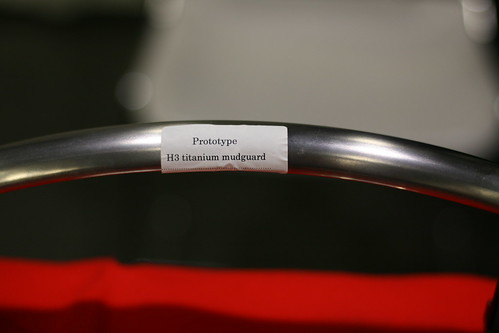
Honjo fender - titanium prototype H3

The rep tells me they plan to begin production of this H3 Titanium Mudguard beginning sometime in the spring. Titanium fenders would look mighty fine on just about any custom bike.


Historical bike prints, cheap at NAHBS

Brett Horton of San Francisco has a huge collection of bike photos collected from around the world. He’s now making prints from his Horton Collection available for sale. Buy them this weekend at the North American Handmade Bicycle Show in Sacramento for a hugely discounted price. These framed and autorgraphed 20×24 prints of Eddie Merckx can be had for a ludicrously low price.

NAHBS 2016 photo dump

Numerous 8×10 prints are also available for $12.95 unframed, or $26.50 framed.

NAHBS 2016 photo dump

As of now they’re only available at the show. They’ll eventually be available for sale online, but expected prices to be nearly double what they charge at NAHBS.

NAHBS continues through Sunday afternoon at the Sacramento Convention Center. For more info, visit the NAHBS website.

New California environmental regs will (hopefully) boost active transportation

Changes to the transportation analysis guidelines specified in the California Environmental Quality Act (CEQA) should ease approval of infill and urban development, but may result in challenges for local governments that depend on Level of Service mitigation requirements to fund their road infrastructure projects.

Find the sad bike?

TL;DR Summary

  • Under current California environmental law, if a project creates significant impact to traffic “Level of Service” (e.g. through longer delays at nearby intersections due to increased cars), the developer may be required to pay for expanded road capacity to mitigate the impact of this development. This policy encourages sprawl development and more motor traffic, contrary to California’s greenhouse gas emissions policies.
  • Under proposed guidelines, Level of Service mitigation will go away, to be replaced with “Vehicle Miles Traveled” (VMT) analysis. If a project will increase the number of miles traveled on nearby streets in vehicles, the developer may be required to pay for mitigation to reduce this increased vehicular traffic.
  • Many cities and counties depend on Level of Service “improvements” paid by developers for their road infrastructure funding. They’ll need to develop new funding models.
  • This discussion pertains to changes in California, but these Level of Service mitigation policies are common across America. Read below to learn how LOS analysis policies that encourage capacity “improvements” make traffic congestion worse, not better.

(more…)

Santa Cruz builders at NAHBS 2016 in Sacramento

All of the usual suspects from Santa Cruz County will return with their selection of beautiful wares at the 2016 North American Handmade Bicycle Show beginning Friday, February 26, 2016 (tomorrow!) at the Sacramento Convention Center. I can’t get over John Caletti’s show bike, the CALETTI X KILLE, so let’s talk about that first.

caletti x kille

(more…)