Category: news

Mountain View California: 22% of capital budget for bicycle / pedestrian projects

The city of Mountain View, California approved an $18.6 million capital budget for fiscal 2014 that includes over $4 million in projects to improve pedestrian and bicycle mobility during the city council meeting on June 18, 2013.


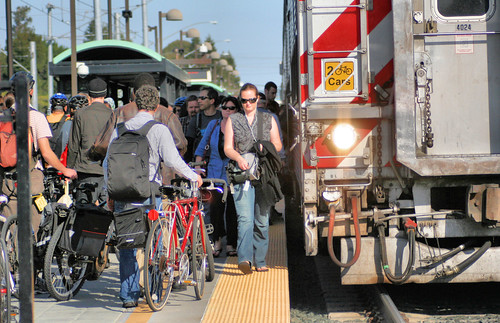
Bikes On Board

This Silicon Valley city of 75,000 is home to several well-known high tech businesses such as Google, Intuit, Symantec, the Mozilla Foundation and Eye-Fi. The city council dramatic increase in bicycle and pedestrian spending reflects one of the city’s three goals for the fiscal year, which is to improve bicycle and pedestrian mobility. During the budget process, the city received several comments from the public indicating a desire to create an environment that makes walking and bicycling, as well as other alternative forms of transportation, easier for its community members. The US Census 2011 American Community Survey shows 6.2% of Mountain View residents commuted by bicycle, nearly matching the 6.3% who bike to work in Portland, OR. Another 6.5% use public transportation.

The city allocated 22% of its capital budget to make walking and bicycling safer and more prevalent. Projects include an update of the city bicycle transportation plan, narrowing a portion of Castro Street, implementation of and local funding for a Safe Routes to School Program, trail and other bike facility improvements throughout Mountain View, and new bike racks downtown. Google, which is headquartered within Mountain View, donated $435,000 dollars specifically for bicycle projects in addition to the millions the Internet search company pays in property taxes and leases on city-owned property.

Read more at the Mountain View Voice: Bike-pedestrian upgrades coming to a street near you / Google gives city’s bike and pedestrian network $435,000 boost.

Former Trek Bicycles exec considers bid for Wisconsin governor’s office

Former Trek executive Mary Burke may run as governor of Wisconsin, says the Milwaukee Journal-Sentinel.

last month, a poll was conducted testing the viability of Mary Burke, a former state commerce secretary and former Trek Bicycle Corp. executive.

The poll was conducted around the same time an unknown person registered five Burke-themed Internet addresses, such as BurkeForWisconsin.com and BurkeForGovernor.com. None of the websites are active.

Burke, who was elected to the Madison School Board last year, has not responded to interview requests since the poll surfaced in June. Mike Tate, chairman of the state Democratic Party, issued a statement at the time saying Democrats were conducting polls for “several potential strong challengers” to Walker.

Burke would run against incumbent Scott Walker, who is known for boosting highway spending in his state while slashing other spending, including that for bicycle and pedestrian projects although the Wisconsin bicycle industry contributes $1.5 billion annually to the state economy.

Burke is a daughter of the late Richard Burke, founder of Trek Bicycles. She earned a finance degree from Georgetown and an MBA from Harvard, which she used to run Trek’s European operations before directing forecasting and planning for her father’s company.

Details in the Journal-Sentinel: Could former Trek Bicycle executive Mary Burke unseat Scott Walker?

Green paint on Hedding Street

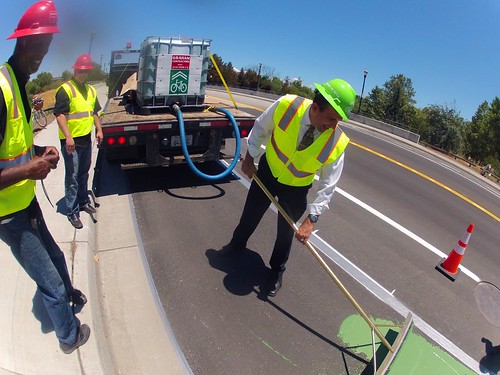
San Jose city council member Sam Liccardo, who represents the city’s downtown district, applies green paint to the asphalt on Hedding Street just east of Highway 87 during a press event.


Hedding Street bikeway press conference

This event announced the start of the Hedding Street green bikeway project, which is San Jose’s first green bike lanes. San Fernando Street will come later this year.

You can view video of the press conference here if you’d like. Liccardo gave the best (which is to say, the shortest) speech.

Lady Fleur got a photo of me looking like a dork that you can view here.

Green bike lanes roll out Wednesday in San Jose

On Wednesday, June 26, 2013 at 1:00 p.m., representatives from the City of San José, Our City Forest, and the Silicon Valley Bicycle Coalition will roll paint in an effort to get more bicycles rolling in the city. The event will take place on Hedding Street at the Guadalupe River Trail on the west side of Highway 87. The painters will inaugurate San José’s first green colored pavement in a marked bikeway – a mile and a half bike lane on Hedding Street, connecting the future Berryessa BART station in East San José to the Guadalupe River Park and Trail, which runs north-south through downtown.


Hedding Street Green lanes media event location on Hedding Street on the Guadalupe River Trail.

(more…)

A Federal Complete Streets law?

Bipartisan bill to require Complete Streets policies nationwide.

Congresswoman Doris Matsui (D – CA) and Congressman David Joyce (R – OH) introduced bipartisan legislation that would ensure our nation’s roadways are built with all users in mind – including bicyclists, public transportation vehicles and riders, motorists, and pedestrians of all ages and abilities. The Safe Streets Act of 2013 would require each state to implement a Complete Streets policy within two years that ensures all new federally-funded transportation projects accommodate the safety and convenience of all users.
San Fernando Green Bikeways

Representative Matsui introduced a similar bill in 2011 with Representative Joyce’s 14th District predecessor, Steven LaTourette (R-OH). H.R. 1780, “The Safe & Complete Streets Act of 2011,” died in the House Transportation and Infrastructure Committee. This followed two previous attempts at Federal Complete Streets legislation in 2008 and 2009.

While the National Highway Transportation Safety Administration reported a two percent drop in roadway fatalities between 2010-2011, the number of pedestrian deaths increased by three percent and bicyclist deaths by nine percent over the same period. Research shows that well-designed sidewalks, bike lanes, intersections, and other street features to accommodate all modes of travel can significantly reduce injuries, deaths and automobile crashes. To this end, more than 500 jurisdictions at the local, regional and state levels have already implemented Complete Streets policies to plan, construct, and operate streets that safely accommodate all users.
Walking in San Francisco

“Too many of the roads in our country are designed solely with drivers in mind,” says Matsui of her 2013 bill. “The risks of such design are evident in the number of pedestrian and bicyclist deaths and injuries we see every year, and often discourage more people from considering other transportation methods,” said Congresswoman Matsui. “That is why I am pleased to introduce the Safe Streets Act of 2013, bipartisan legislation that would ensure our communities’ streets are developed with all users in mind. Complete Streets policies have been a major success at the local and state level, saving lives, easing congestion, fighting air pollution and creating forward looking projects that provide lasting value.”

“The Safe Streets Act is another sign that Congress is responding to the demands of the American public for travel options that are safe and convenient for all users of our transportation system,” says Roger Millar, Director of the National Complete Streets Coalition, a program of Smart Growth America. “It should be safe and convenient to drive on America’s streets, and just as safe and convenient to walk, ride a bike or take transit.”

“WALKSacramento applauds Rep. Matsui’s leadership on the Complete Streets issue. The City of Sacramento has too many streets that are dangerous for pedestrians. But many of these streets, such as Fruitridge Road, qualify for federal support. We need a federal Complete Streets measure to provide the funding and direction to make our streets safer for all users,” said Teri Duarte, executive director of WALKSacramento.

“Sacramento has been a national leader in the movement to ensure that our public streets and roads conveniently and safely accommodate all those who use them, including those who aren’t traveling by car. We are grateful for Ms. Matsui’s leadership in continuing to champion Complete Streets as a federal policy,” said Jim Brown, executive director of the Sacramento Area Bicycle Advocates (SABA).

The Safe Streets Act of 2013 is supported by numerous organizations including: AARP, Transportation for America, the American Society of Landscape Architects, the Safe Routes to School National Partnership, the American Planning Association, the League of American Bicyclists, and the National Association of Realtors.

[Press release from Matsui’s office]