
Most of you know my evening commute includes a bus ride from San Jose to Santa Cruz. Outside is chilly, but the bus is warm, so I remove my gloves and hat when I board. As we approach my stop, I zip up and don my hat and gloves.
The other day, the bus lights were off as I reached into my bag for the hat. I felt something suitably elastic and hat-like, pulled it from the bag and onto my head. And that’s when I noticed the leg holes in the hat. Because it wasn’t my hat — it was my underwear.
Oops. I think that counts as my most embarrassing moment of the month. How about you?
Bicycle news
Catch 22: Part of Asti Road in Sonoma County is closed to all traffic, including bicycles. Large sign advises traffic to “USE HWY 101.” The CHP Golden Gate Division tells cyclists, however, “The sign that says ‘Use 101’ is intended for motorized vehicles” only. (The Asti Store Road workaround suggested by the county is an unmaintained potholed mess — and Sonoma County cyclists can expect more of the same as funding fails to keep up with the county’s road maintenance needs.
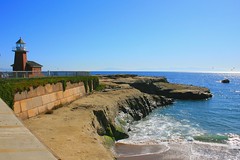
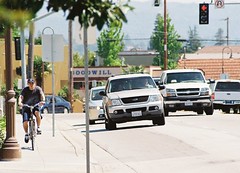
Santa Cruz — Compare and contrast
The view on West Cliff Drive.
The view on Mission Street.
Photos: Richard Masoner
Santa Cruz Bike Route: The Pacific Coast Bike Route currently routes touring cyclists down Santa Cruz Mission Street. This was initially planned because of the multitude of traveler services along Mission. Mission, however, has substandard lane widths and is also the busiest street and the deadliest to cyclists in Santa Cruz, and most local cyclists take alternate routes. Caltrans wants to change the route to follow West Cliff Drive (right on the Pacific Coast) instead. The city of Santa Cruz, however, will have to pay to replace the bike route signs. Council votes on this today.
San Francisco: Most dangerous city! This honestly surprised me: San Francisco is tops in California for traffic deaths per miles driven. It’s also the most dangerous city in California for pedestrians and bicyclists in terms of miles driven or by population. My suspicion: more bikes and pedestrians = that much more opportunity for somebody to get hit. The actual per-person risk may not be that much higher.
Food Policy: The Great Food Crisis of 2011:
[A] major source of demand growth is the use of crops to produce fuel for cars. In the United States, which harvested 416 million tons of grain in 2009, 119 million tons went to ethanol distilleries to produce fuel for cars. That’s enough to feed 350 million people for a year. The massive U.S. investment in ethanol distilleries sets the stage for direct competition between cars and people for the world grain harvest. In Europe, where much of the auto fleet runs on diesel fuel, there is growing demand for plant-based diesel oil, principally from rapeseed and palm oil. This demand for oil-bearing crops is not only reducing the land available to produce food crops in Europe, it is also driving the clearing of rainforests in Indonesia and Malaysia for palm oil plantations.
Another trend slowing the growth in the world grain harvest is the conversion of cropland to nonfarm uses. Suburban sprawl, industrial construction, and the paving of land for roads, highways, and parking lots are claiming cropland in the Central Valley of California, the Nile River basin in Egypt, and in densely populated countries that are rapidly industrializing, such as China and India. In 2011, new car sales in China are projected to reach 20 million — a record for any country. The U.S. rule of thumb is that for every 5 million cars added to a country’s fleet, roughly 1 million acres must be paved to accommodate them. And cropland is often the loser.
Mr. Roadshow: Bicyclin’ Granny lays down the law.
Back to embarrassing underwear incidents: a no pants BART ride took place last weekend in San Francisco.
Embarrassing? But I always wear my underwear on my head on the bus.
If you’re really concerned about using corn to feed people, quit eating meat: Only 10% of the corn produced goes directly to feeding humans while the rest goes to animals. Of the part we do eat about half is high fructose corn syrup. The corn we export goes almost entirely toward animal feed, so the 350 million people figure is in no way accurate.
Ethanol also does not use all that grain. When ethanol is made from corn 1/3 of it goes back into feed as Dried Distillers Grains with Solubles. (DDGS)
But did your underwear keep your head warm?
i hope they were clean 🙂
The consumption of agricultural land for automobiles is dire news for an overcrowded world. Add to that the rising prosperity of many former third-world nations and there will be more people who go hungry. And they may not live in lands formerly associated with poverty.
Another reason to ditch the car.
So… mebbe people will think “it’s California, must be the new trend” ?
I ducked into church and started to take off my snow pants, except I wasn’t wearing any, so it was my pants I was taking off. HOwever, since it was a three layer day, nobody even noticed (and I didn’t get too far in the process).
My 5 yo son prefers that look, underwear on his head that is.
I used to know a cyclist who would cut out the waistbands from this old underwear to use as sweatbands.
Siouxsie Sioux stripping in church – bold!
#blinkblink#
I don’t think that would work for me. I won’t mention why.