Remember way back in 2012 when Governor Jerry Brown vetoed California’s second attempt at a three foot passing law? That version of the bill included a provision allowing passing drivers to cross the double yellow line on substandard lane widths when it’s safe to do so, as demonstrated by the passing Nissan SUV in the photo below.
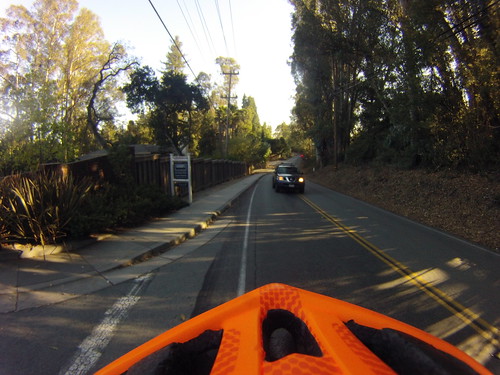
This works because the warrants for no-passing zones are based on sight distances at typical motoring speeds. You might need 200 yards of lane to pass a 12 foot long pickup truck + 18 foot horse trailer traveling 35 MPH and you’re trying to go 40. If I’m pushing my 60 inch long bicycle uphill at 10 MPH, however, you’re over and around in under 20 yards.
CHP opposed this bill because (they say) of this yellow line exception. Brown eventually signed the 2013 followup, AB 1371, which removed the yellow line exception. Ever since then, CHP has passive-aggressively indicated their dislike for the 3 foot passing law in statements to journalists highlighting motorist inconvenience and even the supposed danger created by this law, without any regard to cyclist safety.
The latest example comes from San Luis Obispo, CA, when the CHP Coastal Division PIO Officer Pat Seebart repeated the standard CHP mantra that “We can’t force somebody to break one law to obey another one” and that crossing the double solid yellow is illegal, no questions asked. Never mind that Central Coast law enforcement routinely look the other way when motorists cross the double yellow line when they need to get around elephant seals basking on the side of Highway 1, or when frequent rock slides, fallen trees, roadway flooding or disabled vehicles temporarily obstruct a lane. They’d consider you crazy and weird if you steadfastly insist on strict adherence to CVC 21460 in situations like this. Because many in CHP leadership dislike the 3 foot law, though, they do this silly, underhanded “Golly, shucks, we’re just enforcing the law as it’s written, blame the All Power Bike Lobby if you don’t like it” EVEN THOUGH THE YELLOW LINE EXCEPTION WAS REMOVED BECAUSE CHP DEMANDED ITS REMOVAL.
The story credulously also repeats the myth that riders in California must ride single file in wide bike lanes and shoulders, although no such law exists. The California Bicycle Coalition worked with Assembly Member Ting on AB 2509, which would clarify CVC 21202 — California’s “as far right as practicable” law — to allow side-by-side riding along and strengthen provisions for vehicular-style lane control. Discussions at the state capital, though, revealed widespread misunderstandings about cyclist rights on the road, so efforts to pass AB 2509 have been shelved for now even as advocates work to educate leaders in law enforcement and roadway construction on the benefits for all road users when cyclists get a smidgen of equity on public roads.
The journalist, Kathe Tanner, seems to sound like she’s kinda sorta trying to be fair, but she clearly writes from a windshield perspective. I was going to fault her for failing to get the cyclists’ perspective on these issues, but it’s plausible she reached out and didn’t get a response. Bike SLO County has never responded to my own inquiries regarding Central Coast cycling issues. A couple of folks associated with the San Luis Obispo Bicycle Club have responded after a day or two, but they’re a riding club, not an advocacy group. UPDATE: I was wrong — BikeSLOCounty has indeed responded to my inquiries, and I apologize to them for my faulty recollection. I’ve also been told the journalist reached out to unnamed “noted cyclists,” but the local advocacy group wasn’t among them.
In the future, I ask her and other SLO County reporters to contact the California Association of Bicycle Organizations and the California Bicycle Coalition if you’d like a fair and balanced treatment of any issues that might involve cyclists. CABO in particular has been paying close attention to the Central Coast lately because of some local airheadedness from the Caltrans District here.
With a tip of the hat to Cyclelicious reader Wendy D from Marina, CA for this.