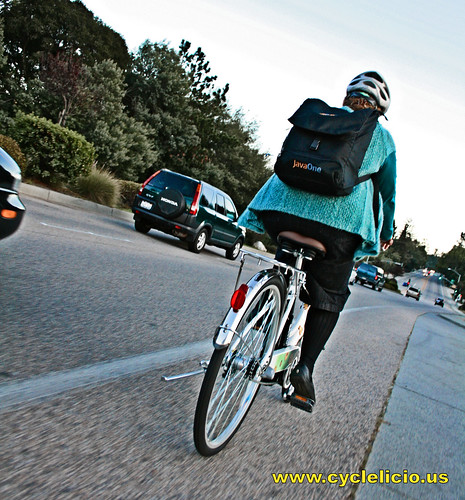
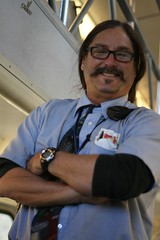
I don’t have an especially outgoing personality, yet I generally have little problem approaching complete strangers when we’re on bikes, talking with them and often enough shooting photos of them. I have little in common with many of the bike riders I see on Caltrain and the bus, but I know about their families, where they work, where they live, and what’s going on in their lives. I even know some of the train conductors and bus drivers by name, where they grew up, and their retirement plans. This guy — who I met at a Caltrain meeting — even rode his bike all the way over the Santa Cruz Mountains for my wife’s college graduation party. This guy has shown incredible kindness to me and my family.
 I’ve assumed this was part of the magic of public transportation: instead of the forced anonymity of the single occupant vehicle, we have the social interaction of a lively public space. The old timers help the newbies, we share food and drink on the train, and sometimes might see the impromptou onboard bike repair clinic. A few of us are even joking about a rolling Caltrain onboard bike film festival some day, which might be a good way to weed the non-cyclists off of the bike car.
Murph describes the Caltrain love as he writes about the 49ers victory over the Chicago Bears last week.
I am of the Caltrain ilk, where everyone helps each other out, we share a bond formed through numerous Caltrain disasters that have forced us to finish our commutes like the Israelites heading out of Egypt, where we rely on each other. The cyclists form a paceline and head to Millbrae BART. Those without bikes gather ’round the twitter and call cabs to split to various destinations, or offer rides in their own cars when a loved one comes to the rescue. This all seems very natural.
In his latest blog post, Tom Vanderbilt (author of Traffic), though, mentions old sociology studies that observe the “civil inattention” on subways — the movie version of public transportation where your fellow riders are all strangers who don’t talk with one another. We have nothing in common, so we avoid all social interaction.
Or is public transportation an opportunity to meet people and even, as Vanderbilt concludes in his Slate article, a way to fall in love?
One recent study conducted by officials at the Paris Metro—which looked at “missed connection” ads placed by urbanites looking for love in the city—found that the Metro “is without doubt the foremost producer of urban tales about falling in love.” The seats closest to the door, it seemed, offered the best opportunities for falling in love with the proper stranger. “The Metro is not the emotional desert, the social vacuum, that we sometimes believe it to be,” observed the chief of the Paris Metro.
If you ride transit, what do you think? Do you avoid eye contact with the same group of strangers your ride with everyday? Or have you made friends among your fellow bus, train and subway passengers? Does it make a difference if you ride a bike or not?