Author: Richard Masoner

Cycle Chic

“Cycle Chick” is the clever name of Zakka’s cycling blog that shows what real transportational cycling looks like.

Bicycle blog collection

21st Century Citizen asks “Drive? or Bike?” with a bunch of “if only” conditions. “I’d bike if only there were bike lanes, if only gas were $10/gallon, if only I worked from home, if only there were more local stores, if only there were corporate leadership showing the way.” Don’t wait for Obama or Clinton or W or Halliburton to lead you by the hand, just get out and do it. Be the change you want. Via Paul.

Bicycle Design reports on the HyperBike: a huge contraption that solves a lot of non-problems.

Andreas Kloden jumps ship.

The cost of physical inactivity calculator. Via.

Dave Moulton posts another excellent article about practical cycling, this time on positioning for comfort and efficiency.

Litespeed quits blogging?

Sartorialist: another bike fashion photo.

Mountain biking: Why riser bars?.

Chris Horner and straight talk on doping in le Tour.

Sue in Chambana wants bike bloggers to brainstorm on bike product ideas. Leave a comment at her blog with your ideas.

Bob Roll visits a bike shop.

Noah in Kansas City asks what to do about the scooter that uses “his” bike rack.

Kim rants about some of the cyclists she shares the road with.

CBB: Simplify your life with the simple bike commute.

City Traffic Commission: Cyclists are insane idiots

Update: See Ms Ballingall’s comment below for her apology and explanation.

The town of Saratoga, California is nestled in the foothills of the Santa Cruz Mountains south of San Jose, CA. It’s a popular area for Silicon Valley road cyclists to ride to and through. While the city of Saratoga considers cyclist safety an important issue, Saratoga Transportation Safety Commission chair Brigitte Ballingall has a different view of cycling. “I think it’s an idiotic sport to do on the road – it’s just insane,” she was quoted as saying in this news about cycling safety in Saratoga.

Cyclists are asked to “be nice” in their emailed comments to her as they explain that cycling is a relatively safe activity that can be enjoyed by almost anybody. For more information about the Saratoga Transportation Safety Commission, see the city website.

Hat tip to Paul on the Silicon Valley Bicycle Coalition mailing list for this news.

Transportation Secretary Mary Peters: Bike facilities a waste

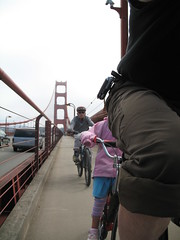
Headless  Panda on the Golden Gate BridgeMy children and I cross the Golden Gate Bridge bicycle path. When counts were last done in 2002, 1600 bicyclists daily rode across on weekdays. Anecdotally, bicycle use has climbed significantly since then. The Golden Gate Bridge and other similar bicycling facilities in the San Francisco Bay Area are a vital part of the transportation network for bicyclists.

Last night on PBS News Hour with Jim Leher, U.S. Transportation Secretary Mary Peters explained the Bush Administration’s policy of no new taxes to fund repairs for the transportation infrastructure. Peters told News Hour that up to 20 percent of the federal gasoline tax is earmarked for non-transportation projects, specifically mentioning bicycling facilities as an example of inappropriate, non-transportation use of the federal gasoline tax.

The League of American Bicyclists responded with a letter to Peters correcting some of the impressions made by Ms. Peters:

  • That bicycle facilities are not transportation related. “Tens of millions of bicyclists and pedestrians in communities across the country use trails to get to work, school, shops, and to visit friends and family,” writes LAB Executive Director Andy Clarke. “Every one of these trips prevents congestion, pollution, and energy consumption while improving the health of the rider or walker.”
  • “You left the impression that an enormous percentage of Federal transportation funds are spent on projects such as these. The reality is that only one percent of these funds are spent on bicycling and walking projects despite the fact that these two modes account for ten percent of all trips in the country and 12 percent of traffic fatalities each year.”

Clarke urges Peters to stand by a statement she made at the 2002 Washington, DC bike summit, where Peters said, “Many people in our country use bikes for more than recreation. For them, bikes are their vehicle for the commute to work and for the errands of daily life. We need every mode of transportation to keep America mobile. What modes did you use to get to your hotel? Very few of us depend on a single mode. I strongly agree with Secretary Mineta, bicyclists are an integral part of our nation’s transportation system and we all need to work together to develop a better more balanced transportation system that provides facilities and programs for bicyclists on a routine basis.”

The LAB also asks cyclists to send their comments to Ms. Peters to share their personal viewpoints.

In the News Hour interview, Peters also praised New York City’s proposed congestion pricing. “I think it’s a great idea,” said Peters. “Commuters today are paying. They’re paying with their time. They’re paying with their productivity. They’re sitting stuck in traffic in New York City and other cities in the United States today. So they’re paying. If this congestion process gives them the ability to get out of being stuck in traffic, to make the air cleaner, to use less fuel, to create a better environment in their city, I think it’s a great idea.”

Elsewhere:

Route from Yonkers, NY to Canton, CT

Tom asks: “I have a question about safe roads. I am planning a trip from Yonkers, NY to Canton, CT. There are many bike trails along the way, but I will have to use the roads in other areas. What is the best way to contact people who know the roads I am thinking of and if I am using the safest means possible?

I’ve visited the areas along New York and Connecticute but I’m not all that familiar with the region. Besides these resources, does anyone have other suggestions for Tom?

Bay Area Regional Rail plans

The San Francisco Metropolitan Transportation Commission, BART, Caltrain, and the California High Speed Rail Authority are unveiling a new blueprint for expanding the system of passenger and freight rail in the San Francisco Bay Area. A series of public meetings in the area will show the proposals to move people and freight through the region in the next 50 years and describe how the regional rail network works in conjuction with the proposed California high-speed rail, along with proposed alternatives for how high speed rail will come into the Bay Area.

The San Francisco Bay Area Regional Rail website includes interactive maps that describe the regional rail network. See the website for a schedule of open houses and presentations that begin today in Oakland, San Jose, Suisun City, Livermore and San Carlos.