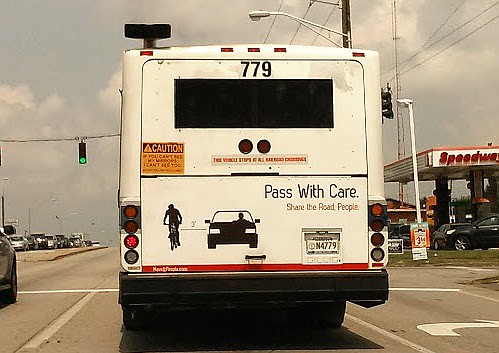
Are far-to-the-right laws specific to bicycles discriminatory? How do they affect your right as a cyclist to use the road?

Posted In advocacy
 November 20, 20137 Comments on Far to the right?
October 23, 20134 Comments on Level of Service and motoring convenience über alles for San Jose intersection
November 20, 20137 Comments on Far to the right?
October 23, 20134 Comments on Level of Service and motoring convenience über alles for San Jose intersection
To serve the controversial Summerhill / Santa Clara Gardens development on the site of the former UC Bay Area Research and Extension Center (BAREC) near Valley Fair Mall, the city of San Jose reconfigured the intersection of Forest Avenue at Winchester Boulevard. The cities removed a signalized crosswalk to improve Level of Service across the intersection to mitigate anticipated traffic demand due to the addition of 275 housing units on the 17 acre BAREC site. What was once a reasonably bike accessible intersection to a bike friendly neighborhood street has become an ugly, bike-unfriendly juncture in what is already among the more car dependent neighborhoods of Silicon Valley.
 October 2, 20132 Comments on Meeting Thursday for Menlo Park bike lanes
Lady Fleur looks at a Menlo Park bike lane where parking is also allowed near a private school on Laurel Street at Oak Grove.
If Laurel Street in Menlo Park is 42 feet wide, how do you divide the roadway so everyone gets what they need? Or should some people’s needs get higher priority than others?
There’s a neighborhood meeting on Thursday, October 3 in Menlo Park where they’ll discuss prohibiting parking all day in the morning-only bike lane near Nativity School, a proposal that’s expected to be unpopular with the school’s parents and teachers.
Laurel is a block north of the Menlo Park Caltrain Station is runs parallel to El Camino Real. This is nominally a north-south street if you think of ECR and Middlefield as north-south boulevards in terms of their direction relative the Bay. In terms of compass direction these are east-west streets. If you live in the Bay Area you understand; if you don’t, you’re likely scratching your head wondering what’s wrong with us.
Two public elementary schools, a high school, two private college campuses, and major employers such as the US Geological Survey and SRI International are all located within a mile of the private Nativity School. The location has an enviable Walkscore of 86. Because Nativity is located within an aging and shrinking Catholic parish, the small school actively recruits students from a broad geographic area, so everybody drives their children to this school.
Northbound Laurel has a bike lane in which parking is also permitted except for 7 AM to 9 AM, which is apparently school drop off time at the private school. Because the alternate parallel streets are Middlefield Road and El Camino Real, Laurel is kind of the only reasonable bike route for children biking to nearby Encinal Elementary School. The heavy drop off traffic on Laurel and Oak Grove and bike lane parking make things challenging for young children on bikes.
The Almanac also picked up the story, credulously accepting the traffic safety credentials of school principal Carol Trelut, who apparently buys into the car advertising myth that surface streets next to schools are for cars only.
Forcing cars off Laurel Street could create a safety hazard instead of solving one, Ms. Trelut said, in situations when Middlefield Road becomes closed to traffic — as it was on Friday, Sept. 27.
“It is the only thoroughfare off of Middlefield Road that you can get a clear shot through, so they have to keep it moving and they have to (be able to) pull out for emergency’s sake,” the principal said.
Ms. Trelut added that the parking spaces on Laurel Street are used by the parents of kindergarteners, who have to walk their children into the school.
Traffic studies Nativity School conducted found at most six to 10 bicyclists traveling along Laurel Street during pick-up and drop-off times, according to Ms. Trelut. “I just don’t understand why” anyone thinks eliminating the bike lane parking is necessary, she said. “Just leave the parking the way it is.”
The Almanac story says the complaint about bike lanes parking was made last year, so I hope there was some discussion about traffic management at the private school. The traffic challenges are greater for private schools because they typically draw their students from a much larger area than public schools, but I’m sure somebody with the traffic safety qualifications of Ms. Trelut can think of some innovative and effective solutions that can improve safety and throughput for her school drop off times.
The Almanac also mentions a problem with illegal parking by students of Menlo-Atherton High School, which is located at Middlefield and Ringwood. Student parking is limited to juniors and seniors at the public school that serves a diverse demographic, from what Forbes Magazine ranks as America’s 3rd Most Expensive ZIP code to the Belle Haven neighborhood located on the other side of Highway 101, where 15% of residents live below the poverty line.
The meeting takes place Thursday night, 6 to 9 PM in the gymnasium at the Nativity School. The school strongly opposes the proposal to remove parking from the bike lane, while local residents seem to be mildly in favor if they care about the issue at all.
September 18, 201310 Comments on The dangerisation of cycling?
Several years ago, Jonathan Maus of Bike Portland began his crusade to excise labels such as “cyclist” from the vocabulary of cycling advocates.
Earlier today, he discovered this paper on the “Language of Promoting Cycling from New Zealand transportation researcher Glen Koorey at the University of Canterbury in Christchurch. Maus is obviously delighted to find this paper “about all the cycling language stuff I’ve been pontificating about for years!”
Koorey believes labels such as “cyclists” identifies us as the scary “other” in the context of communicating to the general public. But I’d like to touch on another hotbutton that Koorey addresses: what he calls “The Dangerisation of Cycling.”
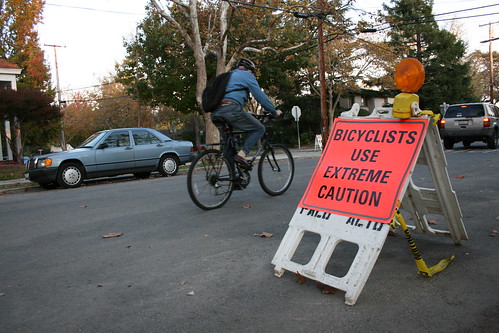 August 16, 20133 Comments on Pedestrian access, safety and the American Automobile Association
As part of their deliberate effort to redefine roadways for the exclusive use of automobiles at the expense of access and safety for anybody else, the American Automobile Association from their founding days recast pedestrians as the scofflaw other, while motorists are almost universally law abiding citizens.
From the February 9, 1922 issue of Michigan Roads and Forests Weekly: “Light percentage of blame for accidents attached to drivers.” You’ve got to love the clearly hyperbolic closing sentence, which claims “The jay-walker is the most serious menace to traffic safety today.”
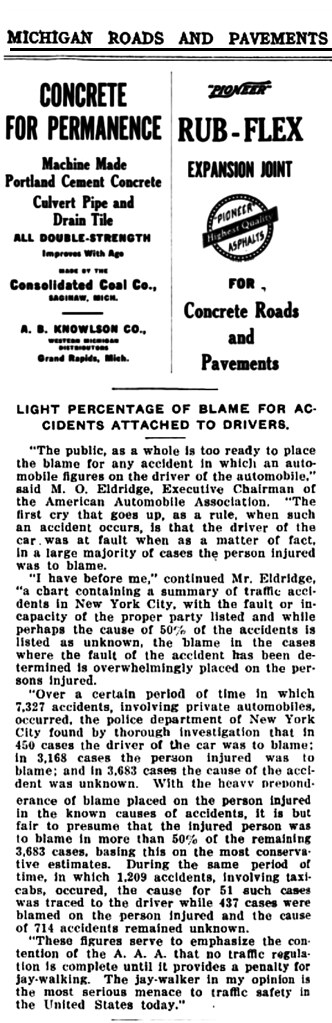
Be very afraid of the deadly pedestrian menace! Punish! Kill! Exterminate!
Or if that seems to messy and extreme, then socialize them to behave better around cars. Even today, California Senators Noreen Evans (Santa Rosa) and Mark DeSaulnier (Concord) believe pedestrians are the problem when it comes to traffic safety, if their Senate Resolution 12 17 is any evidence.
July 19, 20131 Comment on Share the Road in Lexington, Kentucky