In the United States, we market electric cars to celebrate Earth Day. City officials in Medellin, Colombia, however, banned cars from city streets to encourage the use of bikes, walking and transit to work today.
Posted In news
Tagged
 April 22, 2014Leave a Comment
April 10, 20142 Comments on California bicycle legislation update Spring 2014
April 22, 2014Leave a Comment
April 10, 20142 Comments on California bicycle legislation update Spring 2014
It’s time for a California bicycle legislation update. There’s been some action on a handful of bills that might impact bicycling in California, and we’ve already seen a couple of gut-and-amend bills that added to the list of legislation I’m tracking.
 April 8, 20143 Comments on Delaware ditches “Share the Road” signs
The Delaware Department of Transportation announced last November that they would stop using the ambiguous “Share the Road” sign. For the rationale, I’m going to copy the entire article by James Wilson, executive director of Bike Delaware, and Mark Luszcz, chief traffic engineer of the Delaware Department of Transportation, as published in the Institute of Transportation Engineers Bicycle and Pedestrian Council Newsletter and -republished at Bike Delaware.
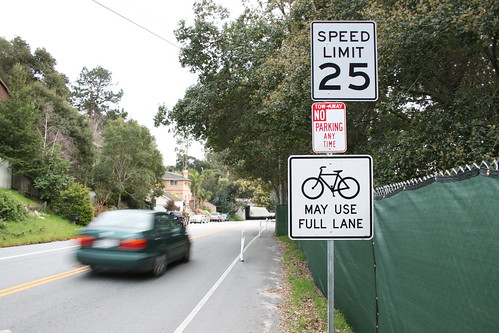
“Share The Road”: It’s practically the national motto of cycling advocacy in the United States.
It’s the cycling “message” on license plates in Colorado, Florida, Georgia, Illinois, Indiana, Iowa, Kentucky, Louisiana, Maryland, Mississippi, North Carolina, South Carolina, Ohio, Oregon, Texas, Utah, Washington, and Wisconsin.
But not in Delaware. In fact, as of last November, just the opposite.
In November, the Delaware Department of Transportation announced that, effective immediately, Delaware would stop using the MUTCD-approved “Share The Road” plaque (W16-1P). More, the department would also start removing all “Share The Road” signs currently installed in Delaware.
How did the state’s cycling advocacy group Bike Delaware react to the announcement that Delaware’s department of transportation was abandoning “Share The Road?” Were there howls of outrage and a letter writing campaign to protest? Actually, Bike Delaware just said “Goodbye ‘Share The Road’“.
Despite its ubiquity and apparent iconic status, it turned out that “Share The Road” is actually an example of common ground between traffic engineers and cycling advocates. We both hated it and for the same reason: its unresolvable ambiguity.
For traffic engineers, with our many years of experience with traffic control devices, “Share The Road” is yet another example of “feel good” signage that placates an interest group but has no safety benefit and adds useless and distracting clutter to the visual landscape.
For cyclists in Delaware (and elsewhere), “Share The Road” had long been interpreted as a sign primarily directed at motorists. Cyclists thought it meant something like “Motorists: be cool.” But for many motorists, “Share The Road” is often interpreted as a sign primarily directed at cyclists and meant something more like “Bicyclists: don’t slow me down.” But we finally realized (after years of pointless yelling back and forth between cyclists and motorists, both yelling “Share The Road” at each other!), that “Share The Road” not only doesn’t help, it actually contributes to conflict and confusion.
“Bicycle May Use Full Lane”
In Delaware, our important task now is to figure out the warrant for the “Bicycle May Use Full Lane” sign.
Perhaps the biggest point of conflict between motorists and cyclists is when cyclists “take the lane” (e.g. cycle in the middle of a travel lane on narrow two lane roads with double yellow lines and without any shoulders). This can sometimes make motorists traveling behind angry. But there is a solid reason that cyclists sometimes ride like this.
Riding at the right hand edge of a travel lane is an invitation for cars behind to pass. That’s fine. But where a double yellow line also exists, it is very easy for a motorist to interpret the combination of the cyclist at the right hand edge of the lane and the double yellow line separating her lane from the lane of oncoming traffic as an invitation to pass in the travel lane. But on roads where the travel lanes are only 10 or 11 feet, this is a potentially catastrophic misunderstanding. The only way for a motorist to safely pass a cyclist when the travel lane is that narrow is to (at least partially) exit her travel lane (into the lane of oncoming traffic).
This type of situation is an example of where the Bicycle May Use Full Lane (and shared lane pavement markings) can both help. The sign delivers a clear traffic control message that makes an ambiguous and confusing traffic situation clearer – for both motorists and cyclists. It’s a big, big improvement over that other sign…what was it called again?
View original at Bike Delaware: Why “Share The Road” Is Gone in Delaware. I think I probably first mentioned an alternative to sharing the road in this blog post.
April 4, 20142 Comments on Regional transportation agency considers bike share expansion to East Bay
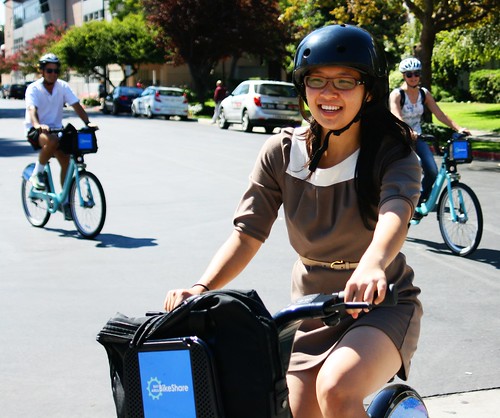
San Francisco Bay Area Bike Share is funded through the Metropolitan Transportation Commission, which overseas transportation planning and funding for the nine-county San Francisco Bay Area. Bike share here serves cities on the west side of the Bay from San Francisco to San Jose.
Ever since program launch, East Bay residents have clamored for a piece of the Bike Share action, and it appears they may see their wish come true.
March 25, 20141 Comment on Entering Tsunami Hazard Zone
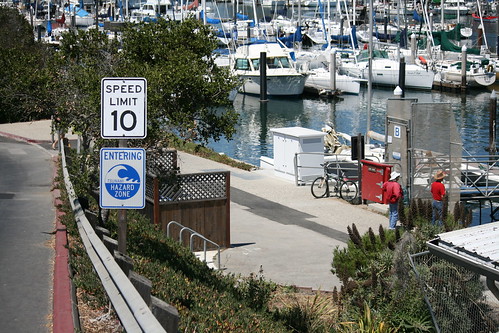
People in Santa Cruz County California were stuck in gas lines and traffic for hours after the 2011 Tohuku earthquake struck Japan. What’s your plan if there’s a real tsunami, and you have minutes to evacuate?
Tsunami Awareness Week apparently began yesterday. People who live in, bike through, and visit coastal California should be aware that tsunamis can be a hazard.
 March 10, 20144 Comments on LADOT says “Don’t block the bike lane”
The Los Angeles Department of Transportation Bike Program office released this “Don’t block the bike lane” PSA last Thursday.
